
Concept
Skill-based routing: Skill-based routing is a feature in call center PBX systems that helps distribute customer requests (calls, messages, emails) to the appropriate department or employee based on the skills required to handle the customer's request.
Instead of distributing requests randomly or sequentially, skill-based routing ensures that customer requests are routed to the agent best equipped to handle the issue effectively. This saves time and enhances the customer experience.
For example:
- If customers need product warranty support, the call will be transferred to a warranty representative.
- If the customer is a VIP customer, the call will be transferred to the VIP Customer Service Department.
How it works
With the role of determining customer needs and assigning them to employees, skill-based routing operates according to the following process:
1. Identify the necessary skills for call center agents
Businesses need to establish predefined skill-based agent routing and distribution channels. Common skill groups include:
- Type of issue handled (information support, payment, complaints, warranty)
- Contact channels (phone, chat, email)
- Language
- Priority level, difficulty of the issue
Depending on actual needs, there are different skill groups. In addition, businesses also need to calculate the appropriate number of personnel for each skill group.
2. Collect and analyze customer requirements
Information collected through:
- Data is available in CRMRetrieve data from the CRM to determine purchase history, priority level (VIP or regular), and preferred language.
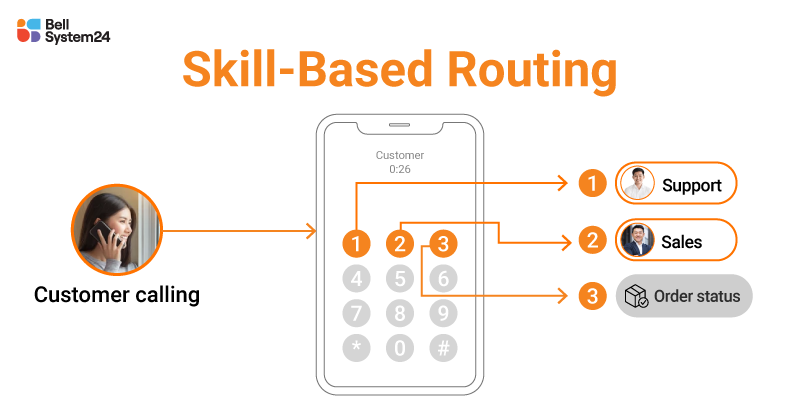
- Information mining using IVRUse IVR voice prompts to guide customers through options based on their needs by pressing keys (e.g., Press 1 for technical support, press 2 for warranty inquiries).
- For text messages: Use an AI system to analyze needs through keywords.
3. Appropriate staff allocation
Based on the information collected in step 2, the system classifies requests and tags the appropriate staff to handle them, then forwards the requests to the appropriate staff.
4. Handling requests
Handle customer requests, forward requests, and provide guidance on next steps (if applicable).
5. Monitor and continuously improve
At the end of the interaction, the system records the conversation information and calculates metrics such as:
- Average talk time.
- Point customer satisfaction assessment.
- Ticket status.
These metrics are used to evaluate employee and team performance, serving as a basis for businesses to develop employee training plans and optimize routing processes to improve service quality.
Considerations when implementing skill-based routing
Route planning closely follows reality
- Develop plans based on historical data or the future direction of the business.
- Ensure the optimal number of personnel required for each skill group, avoiding overloading or surplus resources.
Flexible process
- Design processes that can be adjusted in various situations. For example: The ability to rotate personnel between skill groups during peak times.
- Additionally, infrastructure and technology must be customizable and capable of integrating with other software to optimize business processes.
Ensure consistent employee quality
Employee capabilities greatly impact work performance. Ensure that each employee is always an expert in their skills. Some notes:
- When recruiting employees, focus on a few essential skills.
- Regular training and retraining to maintain and enhance employee capabilities.
Handling unclassifiable requests
Ensure the system can identify unclassifiable requests and forward them to staff who can handle them.
Conclusion
Skill-based routing feature in call center Not only does it help optimize workflows, but it also effectively enhances the customer experience. By assigning requests to the right employees with the appropriate skills, businesses not only save time but also improve service quality. To implement this successfully, businesses need to develop detailed, flexible routing plans and ensure employee quality through regular training and development. The application of skill-based routing will bring long-term benefits, improving work efficiency and customer satisfaction.