

The customer journey is the comprehensive interaction of customers with a business, from the moment they become aware of the brand to becoming loyal customers. In other words, it is a series of touchpoints the interactions customers have with a business — both online and offline — influence their perceptions, decisions, and loyalty.
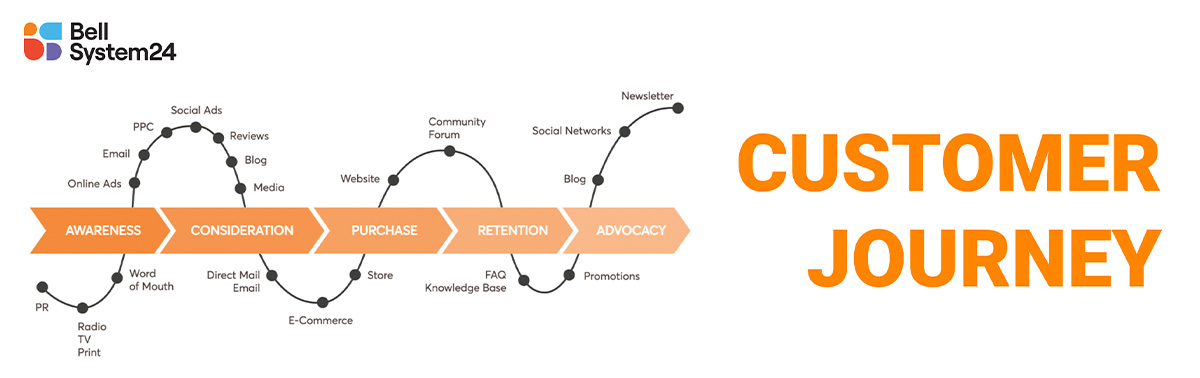
Why is the customer experience journey important?
If every step of the customer journey is smooth, emotional, and satisfying, then you’re not just selling a product—you’re building a long-term relationship. This is why that journey is so important:
Helps understand what the customer really needs
Not everyone buys right away on their first try. If you know what they’re thinking and feeling at each stage, you’ll be saying the right thing—at the right time.
Knowing where customers are experiencing “difficulties” allows you to promptly improve things.
A bad experience at a minor point of contact can also cause a customer to walk away without saying a word. Knowing where the “break” is will help you fix it before it’s too late.
Increase the rate of purchases
A smooth, easy-to-understand journey that creates positive emotions makes customers decide faster and are more willing to spend more money.
Make customers not only buy, but also love and recommend you
People may forget what you sell, but they won’t forget the feeling you bring. A good experience will turn customers into loyal fans – people who are free marketing for you every day.
Create consistency across all channels
Whether the customer comes from Facebook, the store, or the hotline, the experience remains smooth. This is how to build a solid brand in the minds of customers.
Building a journey the customer experience Professionalism not only helps to better understand customers but also optimizes every point of contact to create maximum value.
The basic structure of a customer journey.
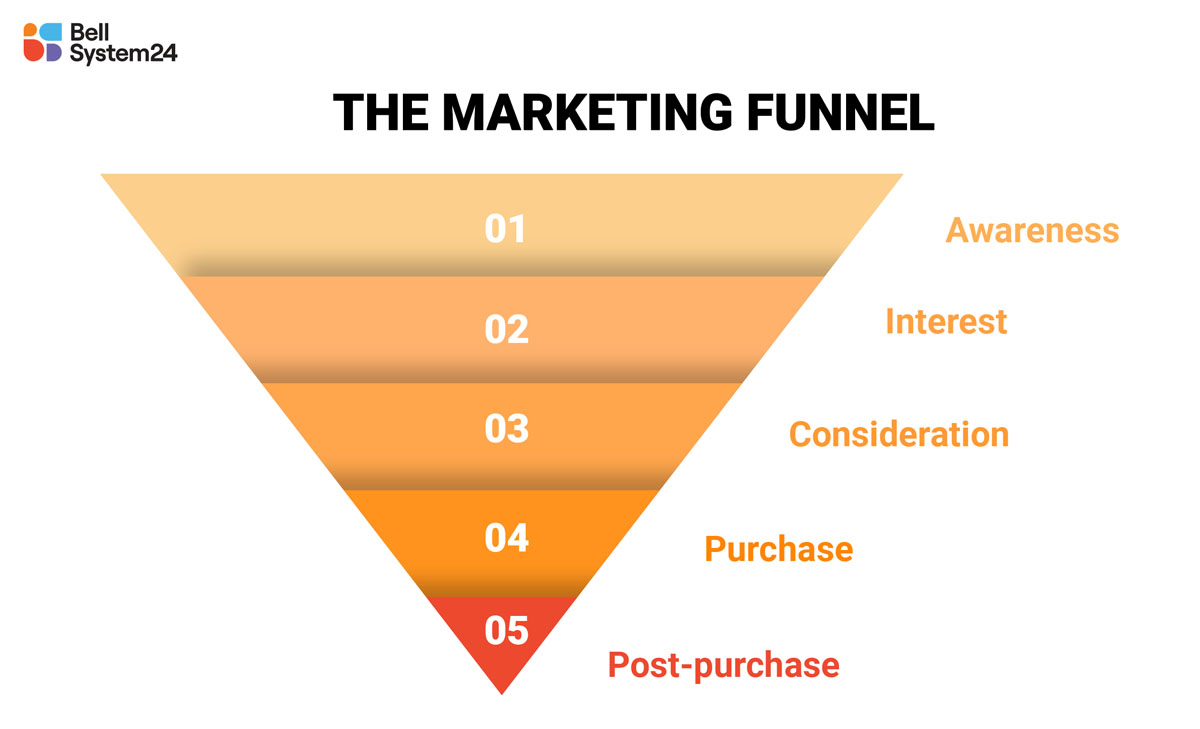
1. Awareness
The customer phase begins when they realize they have a problem or need to be addressed.
Features:
- Customers who are not familiar with your brand
- They are seeking general information about the solution.
- The behavior mainly consists of searching, reading blogs, and watching videos.
Strategy at this stage:
- Create educational content for customers (blog, introductory videos)
- SEO to appear in search results
- Display advertising to increase brand recognition
- PR and media to build credibility.
2. Interest
The customer has identified the problem and started to explore possible solutions.
Features:
- Comparing different products/services
- Learn about the brand, read reviews
- Register to receive information and download documents
Strategy at this stage:
- Create detailed comparison content
- Provide free ebooks and whitepapers
- Educational webinars and workshops
- Email marketing with valuable content
3. Consideration
The client has narrowed down the list of options and is carefully considering the alternatives.
Features:
- Request for quotation, product demo
- Contact the sales team
- Read the case study, testimonials
- Consulting the community
Strategy at this stage:
- Provide a free trial or demo
- Share successful case studies
- Personalized advice
- Special incentive program
4. Purchase
The customer has decided to buy and complete the transaction.
Features:
- Payment process
- Confirm order
- Expectation regarding delivery time
Strategy at this stage:
- Simplify the purchasing process
- Provides multiple payment methods
- Clear communication about policy
- 24/7 customer support
5. After the purchase (Post-purchase)
The customer has completed the transaction and used the product/service.
Features:
- Real product experience
- Need support in using
- Evaluating the level of satisfaction
Strategy at this stage:
- Effective onboarding
- Proactive customer care
- Collecting feedback
- Upsell and cross-sell
See also: Personalize the customer experience, making every interaction special
Guidelines for building a customer experience journey
To build a truly comprehensive and effective customer experience journey, you need to follow a similar process to map out a roadmap for a customer journey from being a “stranger” to becoming a “familiar” brand. Here are the step-by-step instructions.
Step 1: Define the goal
Before drawing the roadmap, it is necessary to clearly determine:
What is your goal? What do you want to improve?
-
Increase the percentage of customers who make purchases?
-
Improving after-sales service?
-
Do you understand why customers haven’t returned for a second time?
For example:
You sell juice. Recently, customers often buy it once and then disappear. Your target might therefore be: Understand and improve the experience after the first purchase so that customers return more often.
Step 2: Determine the customer profile
You cannot build a journey if you don’t know “who is walking on it”.
Therefore, you need to create a few (minimum 2) representative profiles (Customer personas) for your main customer group.
Please provide the information that should be included in the persona:
-
Who are they? (age, gender, occupation)
-
What are their habits and needs?
-
What difficulties did they encounter when choosing your product?
-
What channels do they usually use to find information?
- What is their buying motivation?
For example:
Ms. Linh, 28 years old, an office worker, likes to eat healthy but is busy, often ordering lunch via an app.
→ You will understand: Sister Linh needs an experience fast – easy – reliable, Especially in the ordering and delivery process.
Step 3: List the stages of the experience
Customers don’t “buy naturally”; they often go through a series of emotions and actions. Break the journey into clear touchpoints such as:
-
Awareness → Where did they first get to know you?
-
Consideration → Who do they compare you to? Based on what criteria?
-
The decision to buy (Purchase) → Is the ordering experience quick and convenient?
-
Use & Evaluation (Experience) → Does the product meet expectations? Is it easy to use?
-
Back and Introduction (Loyalty) → Do they have any reason to return? Are they willing to recommend you to their friends?
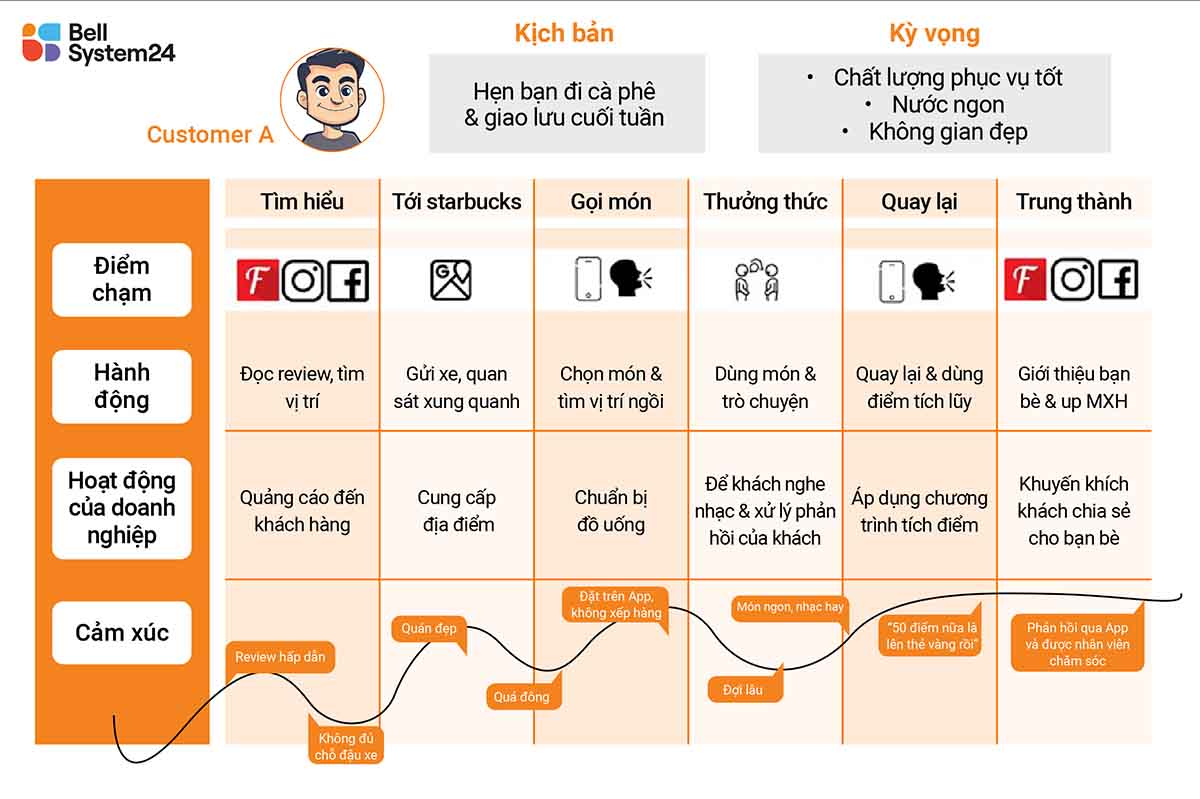
Step 4: Mapping the customer journey
At each stage, customers will interact with your brand through various touchpoints, including:
-
Online: Social media, Website, Google, email, e-commerce platform
-
Offline: Store, employees, product packaging.
List all the touches, then:
- Draw a customer journey diagram according to a timeline
- Mark the main stages
- Identify touchpoints and interpret customer experiences at each stage
Step 5: Record the customer's emotions and pain at each stage
At each touchpoint, customers can:
-
Feeling satisfied → continue on the journey.
-
Or feel uncomfortable → stop immediately.
Once you have drawn the map, determine where the good points are, the acceptable points, and the points that leave the customer dissatisfied.
Step 6: Evaluate and improve the journey
Everything is now clear; now is the time to make improvements:
-
Which place is “The bright spot”? → maintain the status quo, strengthen it.
-
Which place is “breaking point”? → needs to be improved immediately.
Improving the customer experience is the most important goal when drawing a customer journey map, so when designing the experience, keep the following 4 principles in mind:
4 golden principles in experience design:
1. Principle of consistency: Customers must feel that they are interacting with the same brand, whether through a website, Facebook, or when entering the store. It’s like a friend—no matter where you meet them, they still speak and behave in a consistent way.
2. The principle of minimalism: Every step left in the journey is an opportunity for the customer to leave. Think like the customer: “Do I need this step? Will it help me achieve my goal faster?”
Real-world example: Instead of requiring customers to register an account before viewing prices, let them view the prices first and register at the checkout step.
3. The principle of “the right time, the right message” Customers at the awareness stage do not need to know the details of the price, while customers at the purchase stage do not need lengthy educational content.
4. The “Emotional Design” principle” Each touchpoint must create positive emotions or resolve negative emotions. Don't focus solely on functionality while forgetting about emotions.