

A satisfied customer can bring in new customers and increase revenue for the business. Therefore, enhancing customer care efficiency It is a mandatory requirement. However, not all businesses are aware of it. customer care process effective to solve this problem.

Why does customer care need a systematic process?
Customer service Having a structured process is mandatory because it helps businesses implement and achieve the 4 core elements:
- Consistency,
- Efficiency
- Can be measured
- Flexibility to expand.
Without a process, the customer service department will easily fall into a chaotic “firefighting” situation, working on a whim, which is costly and can alienate customers.
At Bellsystem24 Vietnam, we have The project where the call volume of the CSKH call center is seasonal (an average of about 1000 calls per day, but during the holidays it can increase to 5000 per day), therefore, without a well-organized CSKH process, it will lead to a “disaster” on peak days.
A well-designed customer care process not only helps increase the retention rate of customers and also turn them into loyal brand ambassadors. Put simply, Customer Service Good will satisfy many aspects of customer needs., This creates a significant momentum for them to return or introduce new customers to the business.
Customer care process diagram
To maintain customer satisfaction, addressing customer needs must be done in the best possible way and in line with business processes.
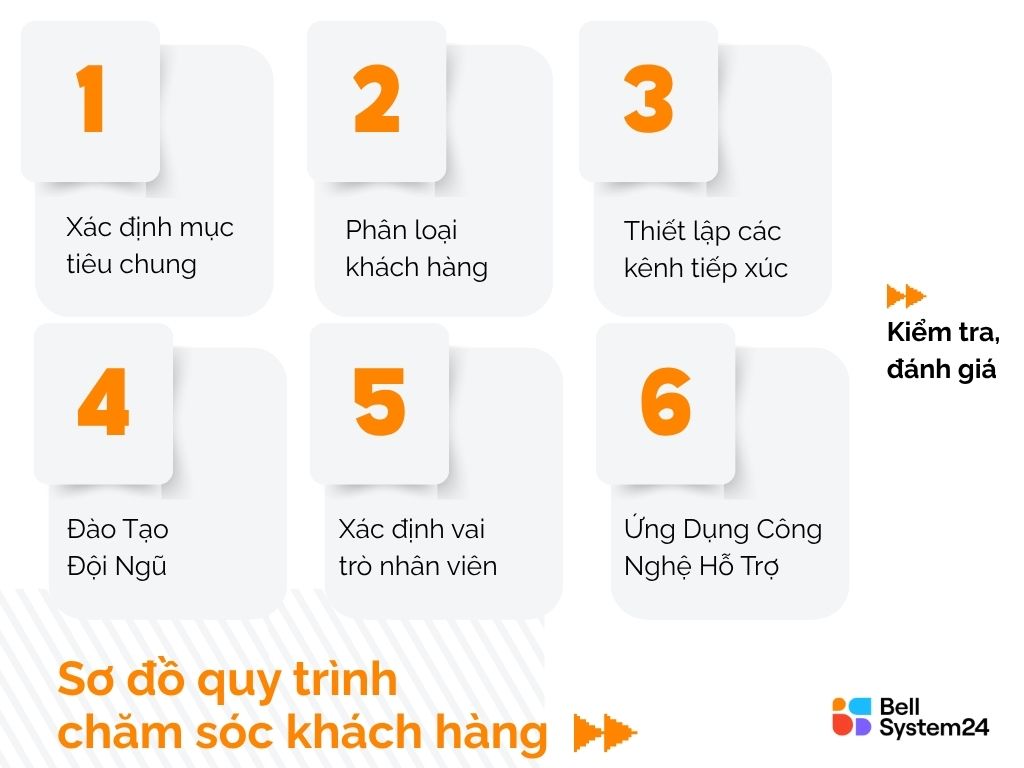
Step 1: Identify common goals
Businesses need to determine the ultimate outcome they want to achieve (retain customers, solve immediate problems, or expand their customer base) for their target customer groups, at certain stages.
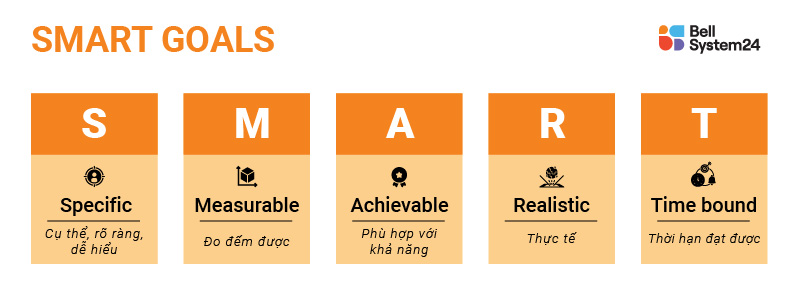
Determine the goals that need to be met according to the S.M.A.R.T principle
The interests of customers can conflict with the interests of the business. Therefore, a rather important detail in the first step of building a customer care process To be It is necessary to determine the limits of customer support capabilities; what businesses can and cannot do.
Examples of customer care goals:
- Increase customer satisfaction score (CSAT) to above 90%
- Reduce response time to under 2 hours
- Achieve a first-time resolution rate (FCR) of over 80%
- Increase the rate of customers returning to purchase by 40%
See also: 10 Customer Experience Metrics
Step 2: Categorize each customer group
Each customer group has different consumption habits and spending capabilities. The process of building a workflow personalized care This will make customers feel more loved, valued, and trust your product.
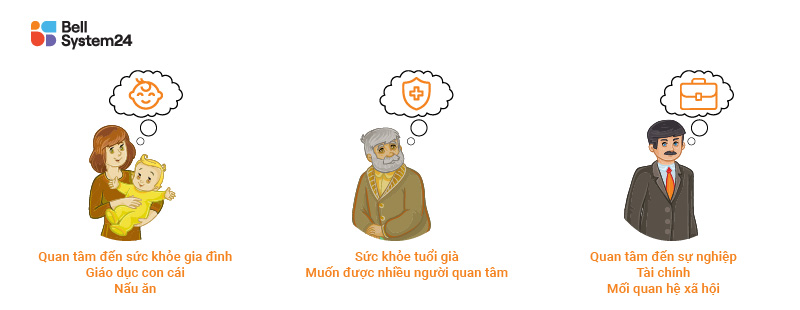
For example, older customers or those who live alone will enjoy conversation more, so businesses need to pay attention to the “little things”. to satisfy the feeling of being heard more.
Step 3: Establish contact channels
Based on customer characteristics, build the appropriate customer care channels. In general, modern customers expect to interact through various channels. An effective customer care process requires integration across multiple channels:
- Call centerTraditional channels are still important for issues that need to be resolved quickly, especially important ones.
- E-mailSuitable for complex requirements that require processing time.
- Live chat: Meeting the need for immediate support while customers are browsing the web
- Social networkFacebook and Zalo help reach customers easily and conveniently.
- AI ChatbotAutomates common questions, operating 24/7
In an era where many businesses view customer experience as a key competitive factor, meeting multiple channels is mandatory – even if not enough; they are also concerned with creating a seamless and consistent customer experience across all channels.
See also: Omnichannel – Enhancing the unified omnichannel customer experience.
Step 4: Training the Team to Care for Customers
People are the determining factor of the success of the customer care process. Employees need to be trained thoroughly in:
- Product/service knowledge
- Communication and problem-solving skills
- Proficient use of support tools
- Customer-centric thinking
In addition to initial training, businesses need to organize regular training sessions and share real-life case studies so that their teams can continuously improve their skills.
See also: Excellent customer service skills
Step 5: Determine the roles for each employee level
Each customer care center All roles are divided based on the increasing priority of the issue. In more detail, each level requires different responsibilities and adaptability from the staff members.
Therefore, the delegation of tasks and Building KPIs Transparent rewards and punishments help employees clearly define their responsibilities and become motivated in their work.
Step 6: Applying Support Technology
Technology helps automate repetitive tasks, freeing up time for employees to focus on more complex issues. Before investing in any tool, businesses need to conduct a comprehensive assessment:
Analysis of current bottlenecksIdentify which steps in the process are experiencing problems. For example: slow response times, customers having to contact multiple times for the same issue, or employees taking too much time on manual tasks.
Gathering feedback from the teamCustomer service representatives are the best people to understand everyday difficulties. Organize meetings and surveys to listen to their actual needs for support tools.
Evaluating size and budgetDetermine the number of employees to use, the number of customers to manage, and the feasible budget. This helps filter out solutions that are within financial reach.
Determine specific goalsWhat problem do you want to solve? Reduce response time by 50%? Increase employee productivity by 30%? Or improve CSAT score to 90%? Clear goals help measure ROI later.
The types of necessary technologies include:
- CRM (Customer Relationship Management)Manage all information and history of interactions with customers in one place.
- Ticketing SystemThe ticket management system helps to track and handle requests in a systematic way.
- Live Chat & Chatbot
- Omnichannel PlatformIntegrate all channels (email, phone, chat, social media) into a single platform
- Analytics, ReportData analysis to gain a deeper understanding of customer behavior and needs, and predict trends.
Step 7: Check and evaluate the effectiveness level
This is an indispensable step in customer care activities. By those Statistics on performance indicators (customer callback rate, complaint rate, product return rate, etc.) will help you have an overview of the current status of your customer service, quickly detect errors and correct them.
The customer care process is not a fixed blueprint but should be regularly adjusted based on feedback and real-time data. Activities to be carried out:
- Collecting feedback through surveys CSAT, NPS after each interaction
- Analyzing bottlenecks in the process
- The organization holds regular review meetings with the team
- Researching new trends in the industry
- Testing and implementing improvements
In addition, the above parameters also help you control the working efficiency of the department. Customer Service, as a basis for making appropriate personnel decisions.
Notes when building a customer care process
Each product, service and target customer has its own characteristics, therefore, a customer care process also need to be regularly reviewed and adjusted when problems arise based on negative feedback from customers or employees.
Besides, you should not just stop at passively handling the problem but also proactively collect feedback from customers through the following tools: Questionnaires, emails, face-to-face interviews,… and from the staff through conducting analysis and research to grasp and predict arising problems.
Evaluate the effectiveness of customer care
Nowadays, we have many indicators to measure the effectiveness of customer care services:
- Net Promoter Score –NPS).
- Customer Satisfaction – CSAT)
- Customer Effort Score ( CES)
- Social Media Monitoring (Social Media Monitoring)
- First response time (First Response Time)
- First Contact Resolution Rate – FCR)
- The level of problem solving required from customers (Customer Ticket Request Volume)
- Average issue resolution time (Average Ticket Handling Time)
As mentioned above, these parameters need to be processed and analyzed specifically to help businesses confirm their strengths and weaknesses, thereby improving quality. customer service.
See also: 10 Indicators to assess customer care performance.
Here is an overview of Customer care process diagram that businesses need to understand to effectively implement customer service activities. You can also connect with Bellsystem24-Vietnam to get advice on customer service solutions suitable for your business.