

According to a survey by S&P Global Market Intelligence, more than 80% enterprise AI projects did not achieve the expected business results, twice the failure rate of traditional IT projects. In 2025, this figure is even more worrying as 42% companies have abandoned most AI initiatives, up from 17% in 2024.
This figure reveals a widespread truth: AI training projects are not for amateurs. In fact, successful companies are increasingly investing more money in AI because it yields impressive returns – an average ROI of 250%. The difference between success and failure lies not in the technology, but in how businesses approach the AI training process.
With the global AI training dataset market expected to grow from $2.92 billion in 2024 to $17.04 billion by 2032, the question is no longer “should we invest in AI?” but “how do we train AI properly?”

What is AI training?
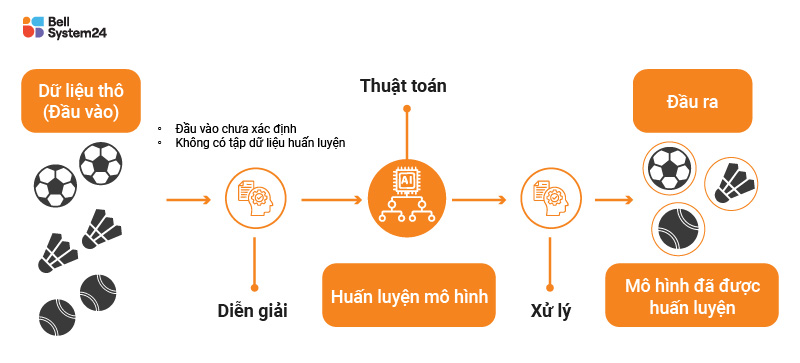
Training AI It is the process of “teaching” an artificial intelligence model to learn to recognize patterns, make predictions, or perform specific tasks through data analysis. Similar to training a new employee, AI models need to be “taught” from data to understand and perform the tasks assigned to them.
Why not use existing AI?
General AI models (LLMs) such as ChatGPT, Claude, or Gemini are trained on large-scale datasets, primarily from public sources and general data. Therefore, they understand only the general knowledge of the industry, but do not by default understand internal processes, business data, or the specific terminology of each business. Personalized AI training enables:
- Customized according to specific business and SOP
- Exclusive proprietary internal data integration
- Ensure security and compliance with regulations
- Achieve higher accuracy for specific cases
When it comes to AI training, many people think that businesses have to build a completely new AI model. In reality, in the vast majority of cases, businesses only need to adapt existing generalized AI models through various methods (such as prompt engineering, RAG, or fine-tuning), depending on the business goals, data, and budget.
Common types of AI training
1. Supervised Learning
It is a method of training artificial intelligence where the model is trained on labeled datasets, meaning that each input data comes with a known correct result. Through continuous comparison between the model's predicted results and the standard label, the model adjusts its internal parameters to reduce errors, thereby learning the mapping rules from the input data to the output result.
In practice, supervised learning is widely applied in fields such as image recognition, natural language processing, predicting customer behavior, risk assessment, credit scoring, and optimizing business operations. This is the core foundation of many commercial AI systems today, where labeled data plays a crucial role in determining the quality and effectiveness of the model.
How it works:
- Input: A photo of a cat
- Label: “Cat”
- The learning model associates the characteristics of the image with the corresponding labels.
Applications in some businesses:
- E-commerce: Automatic product classification (shirts, jeans, sneakers…)
- Banking: Classification of credit risk (low, medium, high)
- Manufacturing: Detecting product defects (defect A, defect B, no defect)
- Customer Service: Ticket classification supported according to priority level
Advantages:
- High accuracy when sufficient quality data is available
- Easy to measure performance
- The results can be explained.
Disadvantages:
- The cost of labeling data is high
- Time-consuming to prepare the dataset
2. Unsupervised Learning
It is a method of training artificial intelligence where the model is not provided with labels. Instead of learning from known results like supervised learning, AI analyzes the data itself to find structures, patterns, relationships, or natural groupings that exist within the dataset.
The goal of Unsupervised Learning is not to predict “right-wrong” according to a predefined standard, but rather to discover insights from the data: which groups of data are similar, which points are unusual, and which characteristics often go together. Learning models are based on the similarities and differences between the data, which in turn form a more meaningful way of representing the data.
How it works:
- Input: 10,000 customer records with multiple attributes
- No label
- The automated customer grouping model has similar characteristics.
Applications in some businesses:
- Marketing: Customer segmentation to personalize the campaign
- Retail: Market basket analysis to suggest products
- Security: Detecting anomalies in the traffic flow.
- HR: Teams of employees with similar skills to optimize teamwork
Advantages:
- No need to label the data, saving costs
- Discover unexpected insights
- Suitable for large, complex data
Disadvantages:
- Difficult to assess the quality of the results
- Experts are needed to interpret insights
- It is possible to find patterns that have no practical significance.
3. Reinforcement Learning
It is a method of training artificial intelligence where the model does not learn from labeled data, but learns through continuous experience and interaction with the environment. AI performs actions, receiving feedback in the form of rewards or penalties, from which it adjusts its action strategy to maximize total rewards in the long term.
Unlike supervised learning (where answers are already available) and unsupervised learning (finding hidden patterns), reinforcement learning focuses on decision-making in a sequential manner: each action not only affects the immediate outcome but also influences subsequent states. The model learns by trial-and-error, gradually deriving optimal policies for each situation.
How it works:
- Agent (agent) performs an action in the environment
- Receiving reward (+points) or penalty (-points)
- Learn how to maximize total reward over time
Business applications:
- Logistics: Optimizing dynamic delivery routes
- Energy: Smart grid management, reducing consumption
- Trading: Automated trading algorithm
- Robotics: Warehouse automation, robot sorting
Advantages:
- Self-study and continuous improvement
- Adapt to changing environments
- Achieving superhuman performance in complex tasks
Disadvantages:
- Time and computational resources are wasted
- The reward function needs to be defined correctly
- Difficult to debug when the model behaves incorrectly
How is enterprise AI training different from individual training?
| Criteria | Personal AI | AI for Business |
|---|---|---|
| Data | Open data | Sensitive, proprietary internal data |
| Data size | Small | Large - Very large |
| Objective | Highest accuracy | Balance accuracy, latency, cost, compliance |
| Security | Not very important | High security requirements, encryption, access control, audit log |
| Compliance | No need | Complying with GDPR, SOC 2, ISO 27001, CCPA |
| Time | Flexible, can take many months | With a fixed deadline, short time-to-market |
| Infrastructure | Computers, personal GPUs | GPU cluster, cloud distributed training |
| Monitoring | No need | Real-time monitoring, alerting, retraining |
| Risk | Less risk | Mistakes can lead to loss of customers, lawsuits, and a decrease in the company's reputation. |
Enterprise AI training process
Training AI in a business is not simply about choosing an algorithm and running a model. It is a holistic process that combines business strategy, data, technology, and operations to ensure that AI creates real value rather than just testing technology.
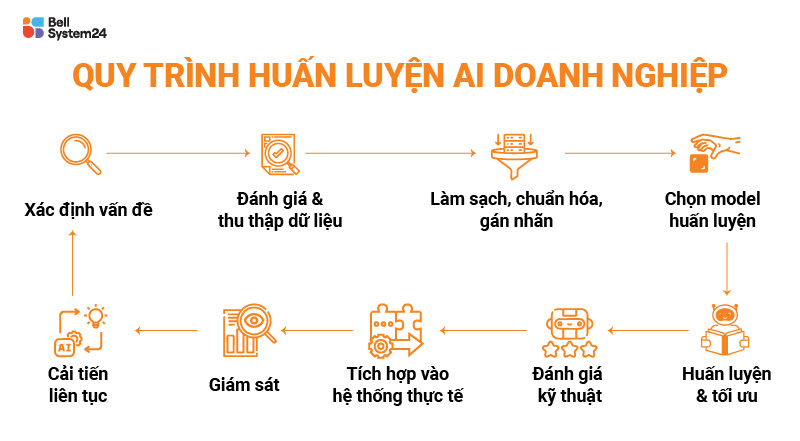
Step 1: Identify the business problem
This is the first and most important step that determines success or failure. AI is not a goal, but rather a tool for decision support or automation. If the problem is wrong or ambiguous, even if the model is accurate, it will not yield effective results.
Businesses need to clarify: Which metrics will AI help improve, in which stages of the process, and how will success be measured.
Some checklists define the goals
- What is the specific business problem?
- AI supports decision-making or automation?
- What is KPI for measuring success?
- Can it be converted into a financial value?
For example
- Predict high-quality leads reduce telesales costs
- Categorizing CSKH tickets to shorten the processing time
Step 2: Collecting and Evaluating Data
Data is the foundation of any AI system. Businesses need to comprehensively assess the existing data to determine the readiness for AI training. At this stage, the question is not “whether there is data,” but “whether the data can be used.”.
The evaluation of the data helps determine the type of model, learning method, and training cost.
6 criteria for quality data for AI:
- Volume (Enough quantity):
- The more samples for each class the better.
- For example: If classifying 20 types of products → need 20,000+ photos
- Variety:
- The data must cover all real-life situations.
- For example: Product photos from different angles, lighting, background
- Veracity (Accuracy):
- The data must be cleaned and labeled correctly.
- True label ≥ 98%
- Velocity (Update speed):
- Are the data “out of date”? Do they accurately reflect reality or align with the current business goals?.
- For example, customer data from 10 years ago will be excluded because it no longer has any re-use value.
- Balance:
- Avoid serious imbalance in the class.
- For example: 99% normal transactions, 1% fraud.
- Bias (Unbiased):
- AI models are biased from the very start of the training data, leading to decisions that do not accurately reflect reality and skew the system.
- For example: Previously, HR prioritized candidates who graduated from certain schools and had experience in large companies → AI would automatically underestimate candidates from non-related industries.
Step 3: Clean and standardize the data
In reality, 60–70% of AI project time is spent on Data processing. Raw data often contains errors, duplicates, missing information, or inconsistencies. If this step is skipped, the model will learn incorrectly and produce unstable results.
The goal of this step is to transform raw data into data that can be learned from.
Standardized checklist.
- Eliminate duplicate and erroneous data
- Handling missing values
- Format and unit standardization
- Labeling
- Feature engineering (creating meaningful variables)
- Training split: Train / Validation / Test
Step 4: Choose the model and algorithm
Not every business needs deep learning or complex models. In reality, the important criteria are stability, easy explanation, easy deployment, and easy maintenance.
The choice of model should be based on the problem, data, and business requirements, rather than following the trend of technology.
Checklist
- Is the business problem a classification or a prediction?
- Do you need to explain the results?
- Real-time or batch request?
- Is the current infrastructure adequate?
Suggested strategy for choosing the starting model:
1. Transfer Learning
Many new businesses are starting to train AI using Transfer Learning. This is an AI training technique where businesses leverage a pre-trained model on large datasets or similar problems, then fine-tune the model for their specific problem. Instead of training the model from scratch.
In the context of enterprises, Transfer Learning is the most practical and effective approach for deploying AI quickly and safely because:
- Using pre-trained models on huge data sets
- Transferring knowledge to a new problem
- Fine-tune your data (part or whole model)
Advantages:
- Significantly reduce training costs and time
- Higher efficiency is achieved when internal data is limited
- Increasing the model's generalization ability
2. Baseline Model:
The Baseline Model is the simplest possible model, built to provide a minimum benchmark to evaluate the performance of more complex AI models. The Baseline is not intended to achieve the highest accuracy, but rather to answer the important question:
“Is our AI model really better than the simplest way of doing things?
If a complex model does not pass the baseline, then deploying it is a waste of resources. Therefore, this model helps businesses assess potential before investing in complex deep learning.
Example of common baseline
- Always predict according to the most common label
- Rule-based (IF–ELSE)
- Logistic Regression
- Simple Decision Tree
Step 5: Training and optimizing the model
At this stage, the model learns from the training data and is continuously adjusted to reduce the error. The optimization not only focuses on accuracy but also ensures that the overall model is good.
Step 6: Evaluate the model
A good AI model is not only one with high accuracy, but one that creates clear business value. Businesses need to evaluate both technical indicators and business indicators.
Some evaluation checklists
-
Classification: Precision, Recall, F1-score, AUC
-
Regression: MAE, RMSE
-
Business metrics: Increase conversion rate, increase revenue, reduce operating costs, and shorten the processing time for work.
Step 7: Implementation in practice
Deployment is the step of transitioning the AI model from the testing environment to the operational environment. This is the crucial phase that determines whether AI will be used or discarded.
Many AI projects fail not because of a poor model, but because of:
- Not integrated into the existing system
- Too slow, too complicated
- Users do not believe or do not want to use it
In business, implementation is not just a technical issue; it also involves the synchronization of operational processes, security, user experience, and decision-making responsibilities. To mitigate risks, many companies have chosen a cautious approach: they test AI in a small business segment or during a specific period (usually low-traffic periods) to assess its effectiveness before deploying it on a large scale.
Common forms of implementation
- Batch processing: runs in batches (end of day, weekend)
- Real-time / near real-time: immediate feedback (chatbot, scoring lead)
- Human-in-the-loop: AI proposes, humans decide in the end
Step 8: Monitoring and operating AI
AI is not stable over time. Data, customer behavior, markets, and internal processes are constantly changing. If not monitored, the model will become less effective without anyone noticing.
This step ensures AI:
- Operation as per design
- Not secretly making the wrong decision
- No risk to the business
Therefore, in enterprise AI, Monitoring & MLOps are essential. mandatory, It is not an option.
The monitoring checklist should be in place
Technical supervision
- Performance decreases over time
- Input data changes
- Error rate, latency
Business monitoring
- Does AI still improve KPIs?
- Has the revenue increased?
- Has the ROI decreased?
- Do users still trust and use AI?
Operate
- Logging all AI decisions
- Warning when exceeding the risk threshold
- Regular retraining schedule
Common issues and considerations when enterprises deploy AI
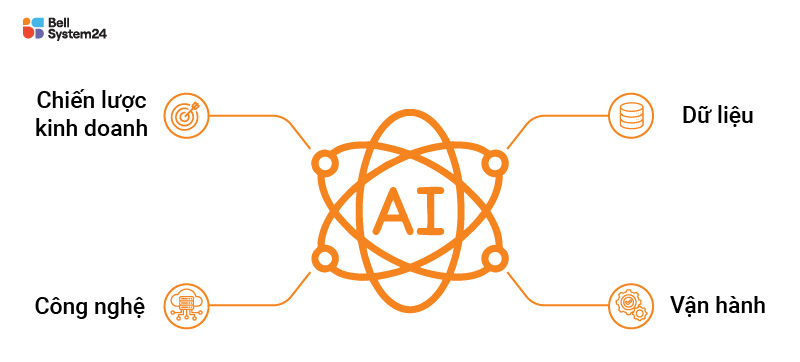
Deploying AI in a business is not just a technological problem; it is a combination of people, processes, data, and strategy. The majority of AI projects fail not because the algorithms are flawed, but because the risk assessment and expectations were misjudged from the beginning.
1. Misidentification of the business problem
Businesses deploy AI because they “see others doing it” or follow the “tech-adornment” trend, but do not clearly determine what the AI will solve. As a result, the model operates technically well but does not create real value.
2. Poor-quality data
There is a determination to build AI, but the data is lacking, inaccurate, noisy, or not representative of the whole, leading to biased models. AI learns incorrectly from the beginning and amplifies the distortion in its operation.
To implement AI training, businesses need Prepare a sufficiently large, cleaned data warehouse.
3. Excessive expectations of AI
Many businesses expect AI to completely replace humans, operate with 100% accuracy, and have low costs. This leads to disappointment. BSV's experience shows that there are still a few businesses that utilize AI very well, but at the same time, most AI projects currently only solve a part of the business process; these are usually repetitive, simple tasks that require large amounts of processing. AI may encounter errors in cases that require complexity, although the rate of errors may be low, but the risks and consequences they leave are difficult to predict.
4. Lack of supervision after deployment
Businesses have implemented AI but do not monitor the changes in models and data, resulting in increasingly ineffective AI that is not detected in time.
5. Failure to control bias and legal risks
Businesses train and deploy AI without assessing and mitigating biases in data and models, and without fully considering the legal, ethical, and regulatory responsibilities associated with the use of AI.
In this case, AI may make biased, unfair, difficult to explain decisions or violate legal regulations, posing serious risks to the company's reputation, finances, and legal standing.
Therefore, it is advisable to:
- Test the data bias before training.
- There is always a human-in-the-loop with sensitive decisions.
- Keep a log and check it regularly.
- Develop policies for operations and liability exemptions.
AI data training service
AI is only intelligent when it is trained with the right, sufficient, and unbiased data.
If your business is struggling to collect data, assign accurate labels, control bias, and ensure compliance with regulations, doing it in-house can be both costly and risky.
Bellsystem24 Vietnam provides the service Outsource professional AI training, including:
- Collecting large-scale data, diverse samples, and following the correct business scenario
- Accurate, consistent, and quality-controlled data annotation
- Process of standardization, security, and legal compliance
Contact us to build a solid data foundation for your AI.