

Theo Salesforce, hơn 91% doanh nghiệp có từ 10 nhân viên đang sử dụng CRM. Tuy nhiên, tỷ lệ triển khai CRM thất bại toàn cầu vẫn dao động ở mức 30–70% (Gartner), lý do không phải vì công nghệ kém, mà vì doanh nghiệp chưa có cái nhìn và chiến lược đúng đắn khi triển khai CRM.
Với kinh nghiệm vận hành Contact Center và phục vụ hơn 300 đối tác doanh nghiệp, Bellsystem24 Vietnam nhận thấy một mẫu số chung: những doanh nghiệp khai thác CRM hiệu quả nhất không nhìn nó như một phần mềm, họ nhìn nó như một hệ thống vận hành lấy khách hàng làm trung tâm.
Bài viết này sẽ phân tích toàn diện CRM: định nghĩa, vai trò thực tế, các tính năng cần có, cách phân loại và quy trình triển khai, để người đọc có cơ sở đánh giá và ra quyết định đầu tư đúng.
What is CRM?
CRM (Customer Relationship Management) — hay quản lý quan hệ khách hàng, là chiến lược kết hợp giữa con người, quy trình và công nghệ, giúp doanh nghiệp quản lý toàn bộ tương tác với khách hàng trong suốt vòng đời, từ giai đoạn tiếp cận ban đầu, chuyển đổi, đến chăm sóc sau bán và giữ chân.
CRM leverages customer information and insights to enhance interaction, sales, and customer care, thereby increasing customer satisfaction and loyalty to the business.
CRM không đơn thuần là phần mềm lưu trữ thông tin.
Đúng ra, phần mềm CRM chỉ là công cụ để hiện thực hóa chiến lược CRM. Nó giúp lưu trữ dữ liệu khách hàng, tự động hóa quy trình, phân tích hành vi và hỗ trợ ra quyết định dựa trên dữ liệu thực tế.
The components of a CRM strategy
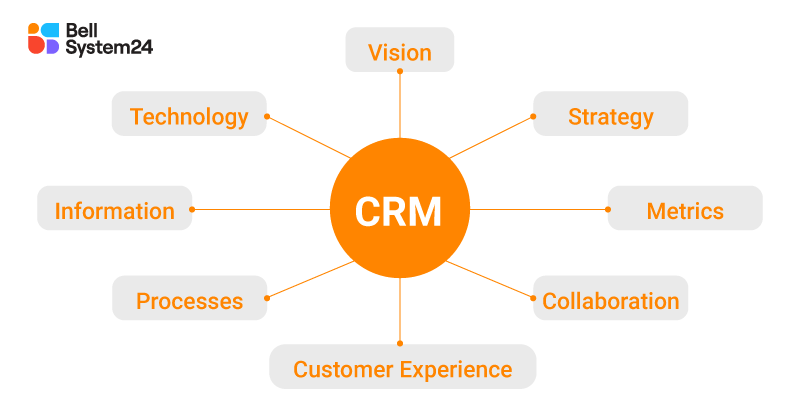
- Vision: Long-term direction for the CRM strategy, describing the ultimate goal related to customers.
- Strategy: A specific action plan to achieve the vision.
- Metrics (Evaluation indicators): Metrics for measuring and evaluating the effectiveness of CRM strategies.
- Collaboration: Coordination between departments and teams within the company.
- Customer Experience: Optimize every touchpoint between customers and businesses.
- Process: Specific steps and activities for implementing CRM.
- Information: Dữ liệu khách hàng được thu thập, chuẩn hóa và phân tích.
- Technology: Tools to support the implementation and optimization of CRM strategies.
The role of CRM for businesses today
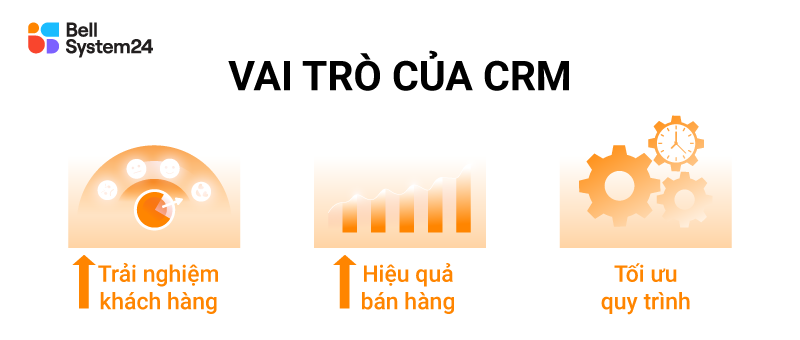
Enhance customer experience
CRM cho phép mỗi nhân viên, dù là tư vấn viên, nhân viên customer service hay đội sales, đều có bức tranh đầy đủ về khách hàng đang tiếp xúc: lịch sử giao dịch, yêu cầu trước đó, phản hồi đã xử lý. Từ đó, mỗi tương tác có thể được cá nhân hóa và phù hợp với ngữ cảnh.
Trong môi trường omni-channel, nơi khách hàng liên hệ qua nhiều kênh khác nhau, CRM là hệ thống giúp hợp nhất dữ liệu tương tác, đảm bảo trải nghiệm liền mạch và nhất quán dù khách hàng chuyển từ chat sang tổng đài hay từ email sang mạng xã hội.
Theo Bain & Company, tăng tỷ lệ giữ chân khách hàng thêm 5% có thể tăng lợi nhuận từ 25–95%, và CRM là nền tảng kỹ thuật để giữ tỷ lệ đó.
Improve sales effectiveness
CRM cho phép đội sales theo dõi toàn bộ pipeline, từ khách hàng tiềm năng, giai đoạn đàm phán đến chốt hợp đồng mà không phụ thuộc vào trí nhớ hay file Excel rời rạc.
Quan trọng hơn, CRM giúp doanh nghiệp phân tích dữ liệu lịch sử để nhận biết tín hiệu mua hàng, ưu tiên leads chất lượng cao và thiết kế kịch bản tiếp cận phù hợp với từng phân khúc, thay vì áp dụng một quy trình bán hàng duy nhất cho tất cả.
Optimize business processes and performance
Khi dữ liệu khách hàng được tập trung trên một nền tảng, các phòng ban có thể phối hợp với nhau theo quy trình chuẩn thay vì mỗi bộ phận tự quản lý dữ liệu riêng. Điều này giảm thiểu sai sót do truyền đạt thông tin, giảm thời gian xử lý (AHT) và cải thiện tỷ lệ giải quyết ngay lần đầu (FCR).
Tạo nền tảng để ra quyết định dựa trên dữ liệu
Mọi tương tác của khách hàng đều là dữ liệu. CRM giúp biến dữ liệu đó thành báo cáo có thể hành động. Thay vì phụ thuộc vào cảm tính, lúc này người quản lý có cơ sở rõ ràng để phân bổ nguồn lực và điều chỉnh chiến lược.
Features of CRM software
1. Customer Information Management
Là tính năng quan trọng nhất của CRM, dùng để lưu trữ thông tin khách hàng trong suốt quá trình bán và sau bán hàng. Nhưng mức độ phức tạp và linh hoạt thì khác nhau đáng kể giữa các giải pháp trên thị trường.
1.1 Upload, store, and update customer information
Businesses can upload lists of potential customers, categorize customers, track nurturing progress, perform customer care, and continuously update information.
1.2 Managing contact information (phone numbers, email addresses, etc.)
CRM manages customer contact information, and it can also integrate with Contact center to interact directly with customers and update data directly on the software.
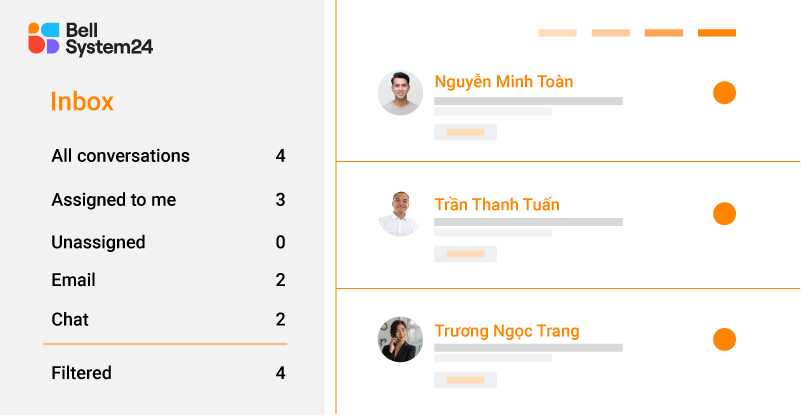
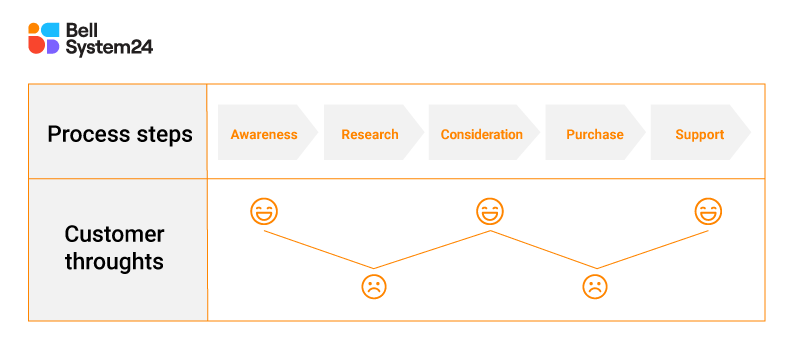
1.3 Customer Journey Management
Store and update information based on interaction history, helping businesses understand which channels customers have used and with whom they have interacted throughout the purchasing cycle.
1.4 Create tickets and support customers
Each customer request is considered a ticket. The CRM system will automatically create and assign tickets to the corresponding departments/employees for processing according to the pre-established SLA. Notify administrators of overdue tickets.
Transaction management and sales process
2.1 Transaction Management
- Record and display complete information about customer transactions, billing information, and inventory withdrawals.
- Automate quotes and contracts.
2.2 Monitoring the sales process
- Store data to track the entire sales process, from the prospect stage, purchase, shipping, post-sales customer care, and warranty.
- Notify the next steps to be taken in the sales process.
3. Marketing features
3.1 Marketing Automation
Integrate marketing tools to automatically send notifications to customers based on specific conditions, for example: Send emails, auto calls, automated chat.
3.2 Customer nurturing
- Segment customers to implement targeted marketing activities.
- Develop scripts and send marketing messages based on specific conditions and contexts. For example: Congratulate customers on their birthdays, wish them a happy new year, etc.
- Create customer files according to the marketing funnel to plan nurturing.
3.3 Marketing Report
Provide detailed reports on marketing effectiveness, which can be integrated with digital marketing tools (such as Facebook, Google ads) to serve as a data feed.
4. Process automation
Help businesses reduce administrative workload and focus on business activities. With CRM, businesses can:
- Establish workflows between departments and individuals, and assign tasks in sequence.
- Monitor work progress, projects
5. Reporting and analysis
CRM data is easily extracted into reports, helping businesses grasp their business situation and make data-driven decisions. Many useful report types include:
- Report on revenue and quantity of goods sold.
- Customer contact volume, customer care index, number of tickets processed.
- Effectiveness of marketing and sales campaigns.
- Analyze purchasing trends and customer preferences.
- Custom reports.
6. Integration with other software
- Integrate with other management software such as CMS, ERP, accounting, etc. to synchronize and avoid data duplication.
- Integrate with communication channels such as Contact centere-commerce platform, webchat to synchronize customer interaction data, creating a seamless customer experience.

CRM Platform Classification
There are three common types of CRM platforms on the market: Cloud CRM, On-premises CRM, and Hybrid CRM.
COMPARISON TABLE
| Criteria | Cloud Customer Relationship Management | On-premises Customer Relationship Management | Hybrid Customer Relationship Management |
|---|---|---|---|
| Definition | It is CRM software that operates and stores data on a cloud platform. It is often provided as SaaS by companies specializing in CRM. | This is CRM software that is built and stores data on the enterprise's server. The enterprise will build, invest in technology infrastructure, and operate according to its own standards. | It is a combination of Cloud and On-premises CRM. Hybrid CRM will store important data and build CRM processes on a local server. The remaining data and communication channels are stored in the cloud. |
| Advantages | - Low implementation costs - No need to invest in infrastructure - Accessible with internet connection and usable on mobile devices. - Easily scale up or down according to usage needs. | - High customization and adaptability, closely aligned with business processes. - Security mechanisms can be designed according to specific standards. (Highly dependent on the technological capabilities of personnel) | - Leverage the strengths of both Cloud and on-premises platforms. - Supports remote work and mobile devices. - High customizability - High security capability |
| Disadvantages | - Customization capabilities are limited if business processes are overly complex. - Security restrictions may be imposed by the provider. | - High investment costs, complex construction - Technical personnel are required for operation, maintenance, and upgrades. | - High implementation costs - Complex deployment and management |
| Suitable for | Businesses need a CRM with comprehensive features and high flexibility, but do not require overly strict security standards. | Businesses require CRM systems that are tailored to their processes, allowing them to maintain control and ensure data security. Government agencies, banks, hospitals, and multinational corporations often choose this solution. | Businesses with high security requirements but still need flexibility. Companies operating in complex legal environments (e.g., multinational companies). |
Should you use open-source, packaged, or customized CRM?
To find out which type of CRM is right for your business, check out the detailed comparison table below.
COMPARISON TABLE
| Criteria | Open-source CRM | Packaged CRM | Custom CRM |
|---|---|---|---|
| Definition | CRM has open source code, allowing users to download and modify it as needed. | Solutions are available from providers, featuring standard functionality, easy deployment, and professional support. | Developed from scratch or extensively modified to meet the specific requirements of the business |
| Cost | Free | Flexible by package | High |
| Features | Basically, many plugins are available because there is a large community supporting them. | Comprehensive, suitable for most businesses. Depends on the service provider. | Designed to closely align with the specific needs of the business |
| Security | Self-management and security setup | Performed by the provider | Self-management and security setup |
| Flexible | Highly flexible, depending on customization capabilities | Low flexibility, dependent on the features available from the provider | Highly flexible, depending on customization capabilities |
| Scalability | High. Can be extended via plugins. | High. Expand by upgrading the package. | High. Expand through self-development. |
| Implementation time | A few months, or sooner depending on the IT team | Quickly, a few weeks | A few months, or sooner depending on the IT team |
| Technical requirements | High. A professional IT team is required. | Low. Due to support from the supplier. | High. Requires a professional IT team or dedicated developers. |
| Featured supplier | SuiteCRM, Vtiger, Odoo CRM | Salesforce, HubSpot | Software design and development companies |
| Suitable for | Small businesses, limited budgets | Most businesses. Have customization needs and security requirements that are not too high. | Large enterprises, specialized industries. High customization and security requirements. |
CRM Implementation Process
Lý do triển khai CRM thất bại ít khi là vì chọn sai phần mềm. Phần lớn thất bại xảy ra do thiếu mục tiêu rõ ràng, dữ liệu không sạch, nhân sự không được chuẩn bị, và không có cơ chế đo lường sau triển khai.
To successfully implement CRM, there must be commitment from the leadership and members of the company, and members need to clearly understand the role and benefits that CRM brings. Below is the standard CRM implementation process for businesses.
1. Set clear goals
Câu hỏi quan trọng nhất trước khi triển khai CRM không phải “Chúng ta dùng phần mềm nào?” mà là “Chúng ta muốn CRM giải quyết vấn đề gì?”
Cần cụ thể hoá nhu cầu sử dụng CRM: Xác định các vấn đề cần giải quyết, như nâng cao hiệu quả chăm sóc khách hàng, cải thiện quy trình bán hàng, nâng cao hiệu quả phối hợp các phòng ban.
CRM objectives must align with business objectives and adhere to the SMART principle. Ví dụ:
- Giảm tỷ lệ churn từ 12% xuống 8% trong 12 tháng
- Tăng tỷ lệ FCR của tổng đài từ 70% lên 85% trong Q3
- Rút ngắn chu kỳ bán hàng trung bình từ 45 ngày xuống 30 ngày
2. Resource allocation plan
The key resources that need to be clearly identified when implementing a CRM system include:
2.1 Human Resources
- Which departments and divisions will use CRM?
- The development of the CRM will be handled by company employees or outsourced. The business needs to clearly identify which departments and personnel will participate in the process of building, testing, and evaluating the CRM in order to plan for a reasonable allocation.
2.2 Investment budget
- Determine the costs of implementing, maintaining, and servicing the CRM.
Doanh nghiệp cần tính đầy đủ các chi phí, không chỉ phí bản quyền phần mềm mà còn phí tích hợp, đào tạo, bảo trì và nâng cấp theo thời gian.
2.3 Time
Xác định mốc thời gian cụ thể cho từng giai đoạn (Milestone). Tránh lập kế hoạch quá tham vọng, việc triển khai theo từng giai đoạn nhỏ thường cho kết quả tốt hơn triển khai toàn diện một lần.
3. Select the appropriate CRM solution
Dựa vào quy mô doanh nghiệp, mức độ tùy biến cần thiết, ngân sách và yêu cầu bảo mật, doanh nghiệp lựa chọn trong ba nhóm đã phân tích ở trên.
Ngoài tính năng, cần đánh giá thêm:
- Tính linh hoạt, khả năng mở rộng/thu hẹp của CRM trong tương lai.
- Ability to integrate with other software in the future.
- Reputable service provider, professional support.
4. Standardize and clean the data
Đây là bước thường bị đánh giá thấp nhất, và là nguyên nhân phổ biến nhất khiến CRM không phát huy giá trị.
Data is like the knowledge base of CRM. Before implementing CRM, businesses need to do the following:
- Clean and standardize existing data to prepare it for import into the system.
- Develop a standard data entry procedure to ensure that the data entry process is always followed accurately and consistently.
- Develop security measures, data classification, and encryption if necessary.
BSV cung cấp dịch vụ xử lý và nhập liệu dữ liệu chuyên nghiệp, hỗ trợ doanh nghiệp trong giai đoạn làm sạch và chuẩn hóa dữ liệu trước khi đưa vào CRM.
5. Training the workforce
Phần mềm CRM tốt nhất cũng trở nên vô dụng nếu người dùng không hiểu cách khai thác. Đây là một trong những điểm thất bại phổ biến nhất trong các dự án CRM.
- Communication plan: Ensure that all employees in the company understand the role and use of CRM in their work. The company can organize regular communication programs about CRM.
- Xây dựng kế hoạch đào tạo trực tiếp cho các nhân sự có sử dụng CRM, có thể kết hợp đào tạo online và offline. Nên đào tạo theo nhóm người dùng, vì nhân viên sales, CSKH, marketing có nhu cầu sử dụng CRM khác nhau, việc đào tạo chung một nội dung là không hiệu quả
- Develop a guidance channel and a set of user guides.
6. Testing
After completing the above steps, it's time to test the CRM. Simulate business scenarios to test it.
- Mô phỏng các tình huống thực tế: tiếp nhận khách hàng mới, xử lý khiếu nại, tạo báo giá, theo dõi ticket.
- Test all features by conducting trials on multiple devices and with different users.
- Identify security vulnerabilities and system errors that may occur in many cases.
7. Implementation and continuous improvement
After undergoing a testing phase, the company can implement the CRM system. The company can test it in phases or in a few small departments before implementing it fully.
- Always monitor performance to address issues in case of errors.
- Monitor performance and compare it with the KPIs set at the beginning.
- Collect user feedback and suggestions regarding difficulties or features that need to be added during use.
- Perform data backups and conduct regular maintenance checks.
Tác động của CRM đến kết quả kinh doanh
Đầu tư vào CRM chỉ có giá trị khi doanh nghiệp đo lường được kết quả cụ thể. Một số chỉ số phản ánh trực tiếp hiệu quả CRM:
Tỷ lệ giữ chân khách hàng (Retention Rate): CRM giúp phát hiện sớm tín hiệu churn — khách hàng không tương tác lâu, điểm NPS thấp liên tiếp, tần suất khiếu nại tăng — để đội chăm sóc can thiệp đúng thời điểm. Tìm hiểu thêm về customer churn rate và cách tính toán chỉ số này.
CSAT và NPS: Khi mỗi tương tác được ghi nhận đầy đủ và xử lý theo SLA nhất quán, điểm hài lòng khách hàng (CSAT) and NPS cải thiện rõ rệt — không phải vì dịch vụ tốt hơn về cảm tính, mà vì quy trình được chuẩn hóa và có thể đo lường.
Hiệu suất đội ngũ: Thời gian xử lý trung bình (AHT) giảm khi nhân viên không cần tra cứu thông tin từ nhiều hệ thống. FCR tăng khi lịch sử tương tác đầy đủ. Năng suất toàn đội tăng khi workflow được tự động hóa.
Operating costs: Tự động hóa quy trình thủ công, giảm sai sót do nhập liệu nhiều lần, và phân bổ nguồn lực chính xác hơn đều đóng góp vào việc giảm chi phí vận hành tổng thể.
Bellsystem24 Vietnam tích hợp CRM với hệ thống Contact Center trong các dự án vận hành thực tế, giúp doanh nghiệp đồng bộ dữ liệu khách hàng từ mọi kênh tương tác và chuẩn hóa quy trình chăm sóc theo SLA. Với 20 năm kinh nghiệm, xử lý 500.000 tương tác mỗi ngày and 300+ đối tác doanh nghiệp, BSV có thể hỗ trợ doanh nghiệp đánh giá nhu cầu và lựa chọn hướng triển khai CRM phù hợp.
Liên hệ đội ngũ tư vấn:
- Hotline: 1900 1739
- E-mail: contact@bs24vietnam.vn
- Form tư vấn: https://bell24vietnam.vn/lien-he/