

The more a retail chain expands, the greater the gap between the standard of service on paper and the actual experience at each point of sale. It’s not because the business lacks processes or training; it’s because no system can simultaneously observe a large number of stores from the perspective of actual customers.
Retail mystery shopping — the secret shopper for the retail chain is the exact solution to that problem. This article goes into what is really necessary to design and implement a mystery shopping program. mystery shopping program effective for retail chains.
Why is retail mystery shopping different from other industries?
Retail has three peculiarities that make mystery shopping more complex than in many other industries:
High store density and wide geographical dispersion.
A convenience store chain, a fashion brand, can operate hundreds of stores nationwide. Ensuring uniform quality of service on that scale cannot be based on periodic internal audits or surveillance cameras.
The experience depends on multiple simultaneous points of contact.
Unlike industries such as banking, hotels, or FnB, where the customer journey has a relatively clear sequence, in retail, customers can move freely within the store, interact with various employees, and end up at the checkout counter. Each of these points of contact influences the decision to buy and the decision to return, and all of them need to be evaluated.
Diverse customers create different experiences.
Even if a business has clear positioning and customer segments, the retail industry’s customer base remains very diverse. A salesperson can serve middle-aged customers with high income well, but they are less likely to proactively approach younger customers who have not yet made a clear purchase intention. Retail chains need to know how their service quality varies among different customer groups.
How is mystery shopping applied according to each chain type?
Each type of retail has its own customer journey, This is an important touchpoint and a separate evaluation criterion. Using a single template for all is the most common mistake in retail mystery shopping program design.
A chain of convenience stores and mini supermarkets.
In this type of business, speed and consistency are the core operational criteria. Customers who visit convenience stores often have specific needs and little time, so the experience is evaluated based on the speed of finding products, the speed of payment, and the neatness of the store space.
Mystery shopping here focuses on:
- Criteria group for store space: Signage layout, product arrangement and pricing, availability of popular products, hygiene and storage temperature
- Service process: Staff attitude, payment queue time
In addition, with convenience stores operating 24/7, it is necessary to consider night shifts as these are usually the shifts with the least supervision and the quality of service is often significantly lower than during regular business hours.
See also: The top 1 convenience store chain in Vietnam uses mystery shopping to manage quality
Fashion and consumer goods chain
In this type of scenario, customers are willing to spend a lot of time on the purchase process, but the decision-making process is more complex due to the influence of many factors. Therefore sales consulting skills and the ability to create employee demand is the differentiating factor between good stores and average stores.
Mystery shopping needs assessments focused on sales consultation attitude and skills: Whether they proactively approach customers or just stand by, whether they ask about needs or simply deliver products as requested, whether they offer suggestions for coordination or upsell naturally, and whether the return process is friendly or not.
Oil and energy services chain
The specific nature of the oil industry is the risk of price fraud; customers often do not have enough information to detect it when they are short of liters or when the meter is manipulated. Mystery shopping here not only assesses the quality of service but also checks compliance: is the meter reset to 0 before filling up, is the selling price correct according to the price list, was the invoice issued in accordance with regulations.
See more Mystery shopping solution for the oil and gas industry.
Car and motorcycle showroom chain
The decision to buy a car or motorcycle is a high-value and time-consuming decision, so customers often visit the showroom multiple times before making a purchase. At the same time, they have very different needs and reasons for buying a vehicle. To successfully sell a vehicle, sales advisors need to truly understand and have the appropriate sales methods, in addition to ensuring compliance with the dealership's sales policies.
Each visit is an experience of service that is evaluated:
- Do the staff remember the guests from the previous visit, and are they providing proper follow-up and care?
- Is the quality of technical and financial advice sufficient to support the purchasing decision?
- Is the test drive and quote process transparent?.
- Fraudulent actions, violations of sales policies (if any)
See also 02 BSV case studies that have been implemented: Quality management of automotive showroom chain services and Check the secret pricing status at the showroom.
Pharmaceutical and healthcare chain
Pharmacies and pharmaceutical chains face very high compliance pressures, such as regulations regarding the sale of prescription drugs, advising the correct dosage, and not selling beyond the recommended dose.
Mystery shopping here combines service evaluation with compliance checks:
- Skills in learning about the patient's medical history and the medications they are taking
- Advice on the correct medication and dosage, precautions, and contraindications.
Points of contact that need to be evaluated in retail mystery shopping
Although there are differences in products and processes, most types of retail chains have four core touchpoint groups that should be evaluated in any mystery shopping program:
Before entering the store: The exterior space, signage, parking lot, and entrance are the first impression groups that create the first impression and form expectations.
Experience in the store: Arranging and displaying merchandise, pricing and product information, common product availability, hygiene and space, lighting and temperature. This group reflects basic operational quality, and is often the group that has the greatest discrepancy between a flagship store and a regular store.
Interaction with staff: Knowledge of the product, consulting and sales skills, service attitude, and handling of difficult situations. This is usually the group that has the greatest impact on purchasing decisions, the likelihood of returning, and is also the group that changes the most from shift to shift, region to region, and person to person.
Payment and conclusion: Queueing and payment time, the attitude of the cashier, the accuracy of the bill, the announcement of promotions or points accumulation, and the farewell greeting are the final points of contact and the determining factor of the customer's emotional response. However, these are often the points where training is least invested.
Design principles for evaluating criteria for retail chains
This is the decisive step in the quality of the entire mystery shopping program and the most common mistake made by many retail chains, in that they try to cram too many questions into the checklist but fail to exploit important insights.
Principle 1: Rank criteria according to the degree of influence
Not all criteria are equally important to customers; they are very clearly differentiated. The attitude of the staff when customers complain affects the decision to return much more than whether or not the staff has a name tag on.
The design criteria should be divided into at least three levels:
- Mandatory criteria (a single violation is a serious matter)
- Important criteria (directly affecting the experience)
- Standard criteria (required to be met but not a determining factor).
Principle 2: Adjusting according to the type of customer and segment
The set of criteria should deeply reflect the unique characteristics of the chain and capitalize on the insights of the target customers.
High-end fashion chains have different criteria for consulting than mass-market ones. Mini supermarket chains in residential areas have different criteria than convenience store chains in offices. The set of criteria must reflect the real expectations of the target customer group, not the expectations of management regarding what “should” be evaluated.
Principle 3: Includes both standard scenarios and contingency scenarios
Evaluating the experience through conventional scenarios is a necessary thing; for example, the process of customers entering the store, the staff serving them, the customers paying and leaving. But this kind of analysis only reveals a part of the truth.
Intentionally written scenario Only recently have we discovered the true culture of service: customers ask about out-of-stock products, request a return without a receipt, and complain about prices that don't match what they paid.
The reactions of employees in these situations vary greatly between good stores and average stores. And it is these challenges that will help assess the service culture more accurately.
Principle 4: Criteria must be paired with action for improvement
A criterion when included in the assessment must ensure that it can be measured and improved if it is not already achieved. If improvement is not possible, including it in the assessment checklist is pointless.
Notes to be considered when implementing on a large scale
Implementing mystery shopping for a chain of 10 retail outlets in Ho Chi Minh City and for a chain of 100 retail outlets nationwide is two completely different challenges, not just in terms of the number of outlets. These are factors that determine success or failure when expanding to a nationwide scale:
The shopper network needs consistent quality.
This is the most technically challenging requirement, directly related to recruitment and training activities.
If implemented simultaneously in multiple regions and different provinces, the mystery shopper network needs to ensure uniform quality. Shoppers in Hanoi, Da Nang, and Can Tho must have similar profiles, apply the same criteria, have the same level of rigor, and use the same recording methods so that data from the three regions can be compared with each other.
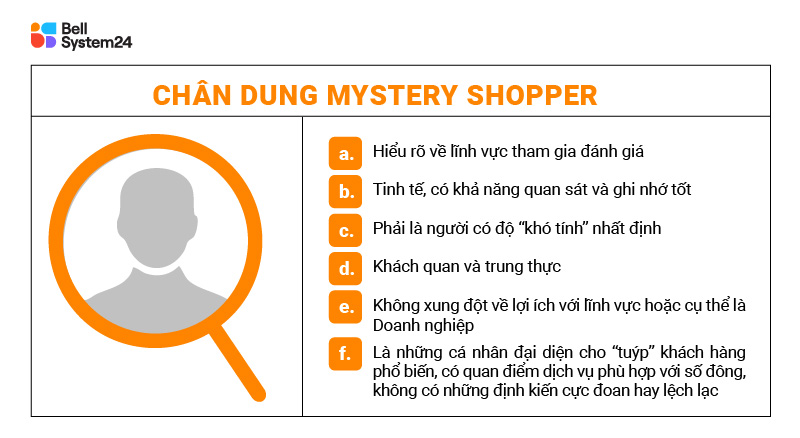
This requires the company to have:
- The process of selecting shoppers according to a unified standard
- Training program according to unified standards
- Training is focused before each assessment period
- Regular checks to ensure consistency
- The mechanism for reviewing reports before they are put into use.
Schedule a reasonable evaluation.
Allocating equal numbers of reviews to all stores is an easy way, but it is not the optimal way.
With the exception of chains that already have highly standardized processes and achieve incredible uniformity. Most retail chains have relatively pronounced differences between regions, so scheduling and frequency of assessments are essential for each store.
- New stores that have just opened need more thorough evaluation in the first few months.
- Stores with low ratings on social media need more frequent updates on Google Maps to find the cause.
- Stores during peak sales periods need to be evaluated to ensure quality does not deteriorate as pressure increases.
Businesses need to allocate resources based on the level of risk to optimize budgets and focus on the right areas that need intervention.
Diversify the timing and profile of assessments.
With retail chains, there is a significant difference in experience between Monday mornings and Saturday afternoons, between morning and evening shifts, between guests who come alone and those who come as a group. The program needs to be designed to cover this diversity, not just evaluate under ideal conditions.
The multi-tier reporting system is suitable for the chain management structure.
The reading of the report and the development of an action plan in the retail industry are influenced by three layers:
- Management: needs to overview the overall system trends.
- Regional manager: comparisons need to be made between the provinces and cities within the region.
- Store manager: you need details according to each criterion to know exactly what needs to be improved.
The same dataset needs to be presented in three different ways, exploiting different issues so that the reader of the report has sufficient data to plan appropriate improvements.
Professional mystery shopping service for retail chains

An effective retail mystery shopping program is not simply about sending people to shop and filling out forms. It requires a set of criteria designed specifically for each type of chain, a carefully selected and trained network of shoppers based on the specific industry requirements, and the ability to implement it simultaneously on a large scale with consistent data.
Bellsystem24 Vietnam has implemented mystery shopping for many large retail chains, including one of the top 1 convenience stores in Vietnam, a gas station chain, and a car showroom, with a nationwide shopper network, standardized processes for each industry, and reporting systems tailored to the large-scale operation of large chains.