

Many businesses signed contracts telemarketing outsourcing With the expectation of increasing sales, and having time to focus on core products. In the first 2–3 months, the results usually meet expectations, and the KPIs are on the right track.
But by the fourth, fifth month, the indicators started to plateau; the conversion rate gradually decreased. The agent still made enough calls, but the effectiveness was no longer the same. The company began to ask questions: Are the outsourced units performing well? Or is this the limit of this model?
In fact, this is not a problem specific to a particular entity. This is the operational rule of the telesale project lifecycle, and much of the decline could be prevented, or at least significantly delayed, if properly managed from the beginning.
How does the life cycle of a telesale project unfold?
Any telesale project, whether small or large, in the financial sector, insurance industry, or FMCG, goes through five predictable stages.
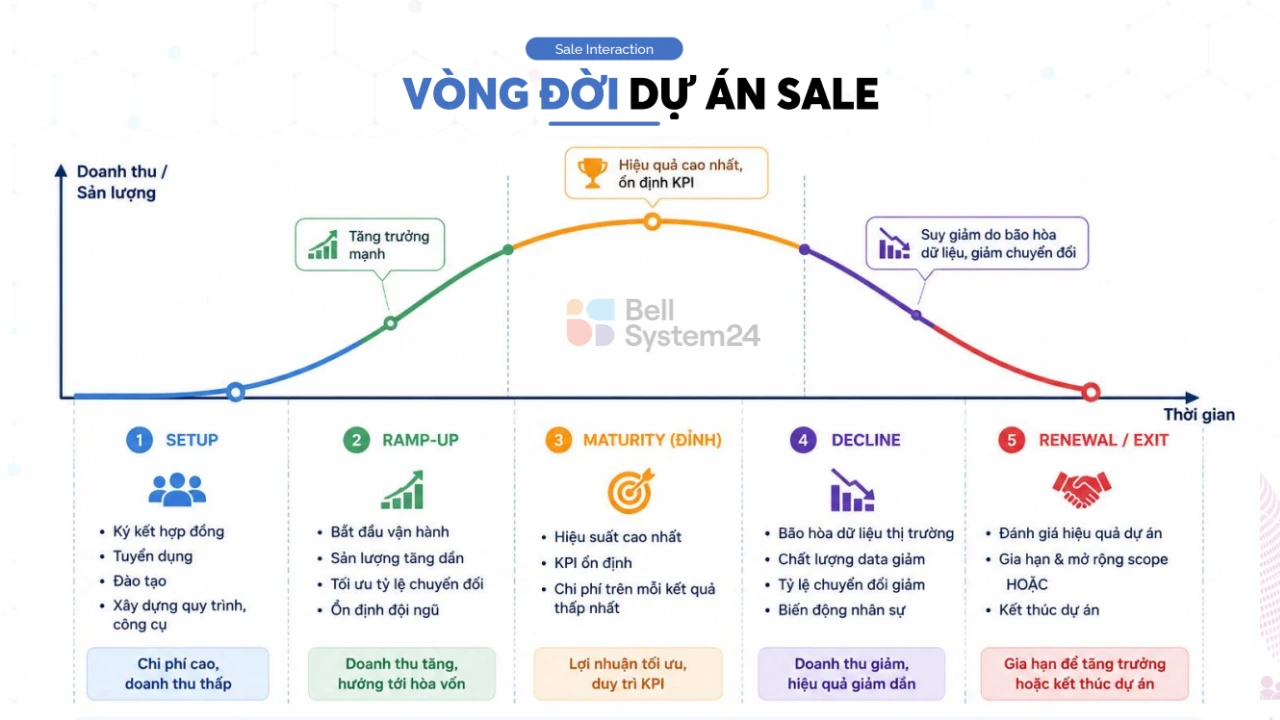
Phase 1 – Setup: High cost, low revenue
This is the foundation phase, which includes activities such as signing contracts, developing SOPs, recruiting and training agent teams, establishing technical systems, and reporting procedures. The operating costs for this phase are the highest, while revenue is almost zero.
The most common mistake at this stage is for businesses to expect KPIs from the very first week. That short-term pressure leads the team to overlook important foundational steps, and the problems will become apparent later, by which time it will be too late to fix them.
Phase 2 – Ramp-up: Growth, towards breakeven
The entire system starts to “run”. Call volume increases, conversion rates improve week by week, and the cost per result decreases gradually. This is the phase where all the charts are going up and also when many businesses start to “let go” and let the project run on its own.
This is the starting point of the problem.
Stage 3 – Maturity (Peak): Highest performance, optimal profit
KPIs are stable. Cost per result is at the lowest level. The agent team operates smoothly. This is the area where every business wants to stay the longest. But according to natural laws, nothing stays at the top forever without proactive intervention to maintain it.
Stage 4 – Decline: saturation and decline
The phase shows that market data is starting to run out. Lead quality is declining. The rejection rate is increasing. Some key personnel are starting to change jobs and want to leave. Revenue is gradually decreasing while operating costs remain the same, and managers are starting to notice that the ROI is starting to decline.
Stage 5 – Renewal/Exit: The next decision
The business faces two choices: extend the contract with a redesigned strategy, or terminate the contract. The right decision depends on an honest assessment of the remaining potential of the market and the ability to improve on both sides.
Why do most telesales projects end up failing after 3-6 months?
When analyzing more 100 telesale projects have been implemented, At Bellsystem24 Vietnam, we recognize that declines rarely come from a single cause. Often, a combination of four issues occurs simultaneously and they begin to manifest as early as when the project is at its peak.
Data is saturated, fuel is running out without anyone adding more.
Telemarketing Running on data is like a car running on gasoline. Because the list of potential customers is not refreshed, it is not re-segmented based on behavior, which means the team is calling back and forth with the same file, using the same approach. The inevitable result is an increase in rejection rates, agents becoming frustrated, and conversion rates dropping.
Data telesales has a clear shelf life. After 60–90 days without cleaning and replenishing, the quality of the data will significantly decrease, especially in industries with high demand variability such as finance, insurance, and real estate.
Agent “familiar with the situation” in a negative direction
The project lacks a continuous coaching mechanism; good agents gradually form a routine, working like a “machine”: scripts become rigid, processing reflexes for rejection are less flexible, and work motivation declines after the feeling of “conquering” is no longer present.
This is not the fault of the agent; it is the result of a management system that lacks continuous feedback loops.
Lack of optimal mechanism from the outsourced entity
Many outsourcing companies provide good reports (number of calls, connection rate, conversion rate per week). But the reports are meant to describe the results, not to suggest solutions. Without an A/B testing approach, without testing new offers, and without adjusting the strategy based on data, the outsourcing company is just operating, not managing strategy.
The setup process is not robust enough
SOP Built hastily in the first week, the knowledge base was incomplete, the onboarding process for new agents was not standardized. As the project needed to expand or when the core agent left, everything started to falter. Every change of person meant a partial reset of performance to zero.
What does BSV do to prolong the growth phase and maintain the peak?
We know that there is no magic formula that keeps a telesales project at the top forever. But there is a set of proven methods that have been applied in more than 300 outsourcing projects at Bellsystem24 Vietnam to significantly extend the most effective phase and slow down the decline process.
1. Data lifecycle management.
Bellsystem24 Vietnam does not consume data once and then use it up. The data of each project needs to be managed as a property with its own lifecycle, requiring continuous care.
- The process includes Data Mining to find and add new potential customers on a periodic basis;
- Data Cleansing to remove invalid phone numbers, re-segmenting leads based on potential level;
- And Reactivation to rebuild the file from customers who had previously declined but were not reached again using another approach.
The fact from the projects that have been implemented: the reactivation campaign at the right time, usually in the 3rd–4th month, can be restored. 10–15% lead from cold data files, without the need to add new data budget.
For projects with large and continuous data needs, BSV adds additional capabilities. Collecting and processing AI data to clean, enrich, and classify data in real time.
2. SOP & Knowledge Base were built from the beginning.
The setup phase at BSV doesn’t end with recruiting enough people and getting the system up and running. This phase ends when the entire operational process is documented in standard documentation. There must be SOPs for each scenario, a knowledge base for handling denials, and a clearly layered script from start to finish.
Scripts are not static. We implement A/B testing and offer it on a weekly basis. We test the opening approach, the handling of the most common rejection scenarios, and the lead to a sales close. The results are measured, compared, and integrated into the main script.
In fact, when applying the standard process, if a new agent joins the project, the onboarding time is shortened to 3–5 days Instead of 2–3 weeks as in models that lack documentation. Every new person starts at the same level of quality.
3. Continuous coaching
For more than 2.000 personnel are trained each year At Bellsystem24 Vietnam, the majority are not new employees but agents who are operating the project, who are trained further according to a fixed schedule and based on feedback from QA.

The mechanism of action is as follows:
- QA listens to calls daily based on sampling, tagging by issue type (stiff scripts, poor rejection handling, lack of urgency, etc.).
- Compile the feedback by shift and transfer it to the team leader for direct coaching.
- Instead of waiting until the end of the month to hold a review meeting, the feedback cycle was shortened to 24–48 hours.
In parallel, BSV applies a KPI gamification mechanism: a weekly leaderboard, and incentives tied to milestone conversions to create motivation to maintain performance without administrative pressure.
For managers who want to improve their leadership skills for sales teams, BSV also provides training sales skills and coaching skills In-depth training for both the client's team leader.
4. Real-time monitoring.
One of the reasons why the project fell into a dangerous situation without anyone having time to prevent it was that the data was only reviewed at the end of the week or the end of the month. When the numbers were already bad in the monthly report, that meant the problem had existed for at least 3–4 weeks earlier.
BSV operates according to a real-time monitoring model through the call center software. Telehub. The dashboard continuously monitors the following indicators:
- Conversion rate per person, per shift
- AHT (Average Handle Time)
- The rejection rate in the first 30 seconds
- Average talk time
- Success rate of call-backs
When an indicator deviates from the standard even by one point, the review trigger is activated immediately, without waiting for the periodic report.
This mechanism allows for early intervention and quick adjustments to the script, additional coaching, or pausing the campaign to test the data before the issue spreads to the entire team.
5. Renew the Offer & Approach strategy on a cyclical basis.
No scenario is good enough to be used for six months without losing its validity. As the market changes, customers become accustomed to old approaches, and what used to be a differentiator gradually becomes outdated.
BSV closely studies customer needs to periodically update its offer and approach, such as:
- Change the way you start a call
- Testing different price points for the product
- Adjust urgency based on the month
- Integrate new social proof when available.
This not only helps maintain efficiency but also keeps the agent team feeling like they’re working with something new, rather than repeating a script they already know.
6. Efforts to stabilize personnel.

In a telesale project, core personnel are the most important asset.
Through training and on-the-job experience, they understand the product, understand the customers, and understand how to handle the most common objections. Every time a core agent is lost and has to be replaced with a new one, the team has to go through a ramp-up period, albeit shorter than the first time.
BSV is always striving to maintain a high level of employee retention. ~80% Through clear compensation policies, development roadmap within the project, and transparent performance recognition mechanisms. When the project needs to be expanded or expanded suddenly, recruitment capacity 200–300 staff/month ensure that there is never a shortage of troops.
Signs that the project is deteriorating and needs immediate action.
The downturn does not occur suddenly. It begins with small signs, and is often overlooked because it remains within acceptable limits. By the time the most important indicators have clearly declined, the downturn has lasted at least 4–6 weeks, and that is enough to make a project impossible to salvage.
Below is a list of early warning indicators that the operating team needs to monitor continuously:
| Signs | Warning threshold | Priority action |
|---|---|---|
| Conversion rate drops for two consecutive weeks | Decrease >10% compared to baseline | Review data quality + try new approach |
| AHT increased abnormally | Increase >15% compared to the average | Listen to calls and receive coaching right this week |
| The rejection rate in the first 30 seconds increased | Over 30% total calls | Check the data, refresh the opening script |
| Agent Core is taking a leave of absence | Any case | Activating the backup plan + accelerating recruitment |
| KH complained about the quality of the calls | Any feedback | Full QA audit of the entire week |
| Average talk time decreased | Decrease >20% compared to last week | Rechecking the script structure and coaching |
Building the habit of monitoring this table and having a clear action reflex when the threshold is exceeded is the difference between a project that is managed proactively and a project that is just being operated.
To better understand how to set it up KPI telesales suited to each stage, businesses can refer to the detailed instructions Calculating and evaluating performance indicators in telesales.
Renewal or Exit: When should renewal be considered, when should it be stopped?
This is a question that many businesses hesitate to ask their outsourcing partner because they fear the answer will be influenced by commercial interests. Bellsystem24 Vietnam approaches this question with an honest assessment framework, based on the actual data of each project.
It is advisable to renew and redesign the strategy when:
- The target market still has room to grow, the data hasn’t really run out; it just needs to be refreshed and re-segmented.
- KPIs have recovered or are showing positive signs (albeit slowly) after implementing the new adjustments.
- The company's product/service is about to undergo changes or additions.
It is necessary to re-scope (adjust the scope) when:
- The demand for seasonal changes requires flexibility to increase/reduce the scale according to each stage.
- It is necessary to add a new channel (from Voice to Omnichannel) to reach other customer segments.
- Business goals change.
It is advisable to end and plan an exit when:
- The data is actually saturated and there are no viable sources of additional data.
- The ROI of the project is no longer reasonable even when cost optimization is applied.
- The business strategy of the company has changed in a direction that is no longer compatible with the telesale model.
Closing a project is not necessarily a failure, but rather a reality of the market; in many cases it is a new opportunity for the business to open a new chapter. A reliable outsourcing partner will speak directly to the business when the best option is to terminate the contract, rather than extend it for short-term gains. This is the foundation for building long-term partnerships.
Conclusion
An effective outsourced telesales project that lasts for a long time is not luck. It is the result of systematic management.
The Ramp-up and Maturity phases cannot be sustained on their own. They need to be designed to last through continuous data care, continuously developed teams, and strategies adjusted to actual data.
If your business is considering implementing or redesigning an outsourced telesales project, the most important starting point is to choose the right partner who not only knows how to operate, but also knows how to manage strategies.
Bellsystem24 Vietnam can provide project design consulting telemarketing outsourcing aligned with the business’s goals and budget — from the setup phase until the project reaches and maintains peak KPIs. Contact the expert team:
- Hotline: 1900 1739
- Email: contact@bs24vietnam.vn
- Registration form for consultation →