
Voice AI, virtual assistants, voice chatbots, and voice recognition systems all operate based on a common platform: voice data. The quality of this data layer will largely determine the accuracy and practical applicability of the model.
Gartner once predicted that by 2026, the majority of AI projects lacking standard data (AI-ready data) would be stalled or abandoned midway, and the most common reason lies not in the algorithms but in the quality of the input data. With voice, the problem is even more pronounced because open data such as LibriSpeech or Common Voice often lack sufficient regional and linguistic diversity, specialized terminology, or the real-world context in Vietnam.
This article analyzes the methods of voice collection for popular AI today, the criteria for evaluating data quality, and the challenges businesses often encounter when implementing them on their own.

What is voice collection for AI?
Voice collection for AI is the process of recording, organizing, and attaching metadata to human voice samples for training or testing machine learning models. This is a specific branch within the broader picture of AI data collection, This also includes text, image, and video data.
Unlike recordings intended for communication or entertainment purposes, voice data for AI is not aimed at a finished, polished recording. Instead, the goal is to create a large enough, diverse enough dataset with accurate labeling so that the model can learn how humans actually speak, including elements that conventional recordings often eliminate such as interruptions, repetition, regional accents, or background noise.
The collected voice data will be fed into systems such as automatic speech recognition (ASR), text-to-speech (TTS), virtual assistants, voice chatbots, or models that analyze emotional speech. Each application sets different requirements for how the data is collected, which leads to multiple parallel collection methods rather than a single process.
Voice collection methods
Recording according to the script
The speaker reads the prepared content, ensuring accuracy in grammar, vocabulary, and pronunciation.
This method is suitable when clean, tightly controlled data is required, often used for TTS systems, voice assistants, or audiobooks. The downside is that scripted voice reading sometimes lacks naturalness compared to how humans actually communicate.
Natural voice recording
Many speakers who participate in unscripted or semi-scripted conversations reflect on the tone, pauses, and emotional expressions in everyday communication.
This is an important source of data for training. voice bot, Virtual agents or systems need to understand the context of multi-party conversations.
Recorded in field conditions
Recordings in an office, public place, restaurant, or environments with real background noise.
This method is necessary when the model must operate stably in complex acoustic conditions outside the lab, such as voice recognition applications in cars or outdoor mobile devices.
Exploiting open data and crowdsourcing
Using public datasets or data collected through crowdsourcing platforms saves time and costs in the idea testing phase. However, this type of data often lacks detailed labels about speakers, uneven quality, and difficulty meeting requirements for specialized terminology or specific regional accents.
Record calls in real operating environment
For businesses that have already operate a contact center, Real call data between employees and customers is a source of natural, diverse voice, and tied to the exact business context that the model needs to serve. This is also the approach that BSV benefits from thanks to its contact center operating platform with 500,000 interactions processed daily, which helps provide voice data that is more closely aligned with the actual usage of each industry than with simulated recordings.
Criteria for evaluating the quality of voice data
A standard voice data set for AI needs to be evaluated on multiple technical criteria, and it should not be limited to audio clarity alone.
Here is a basic checklist for evaluating the quality of AI voice data:
Audio Engineering
- Signal-to-noise ratio (SNR) reaches the appropriate threshold for the usage model (tAt least 15dB, ideally from 20dB or more up)
- The sample rate is correct for the required specifications (16kHz is the most common level for ASR and voice assistants; 44.1kHz or 48kHz is used when higher quality is required; Below 8kHz is usually not sufficient for modern models, unless the target model is telephony voice data).
- Bit rate and file format meet the input standard of the model (16-bit PCM, uncompressed WAV is the most common standard, corresponding to bit rates ranging from approximately 256kbps (16kHz) to 768kbps-1.4Mbps (44.1-48kHz) when measured in uncompressed WAV).
Quality of the transcription
- Accurate to the last word, no editing for smooth reading
- Preserving natural phonological phenomena: repetition of words, pausing, and word endings
- There is a timestamp included if the model requires audio-text alignment.
Metadata
- Speaker information: age, gender, regional accent
- Recording conditions: environment, equipment, level of background noise
- Detailed enough to trace and group the data later
Sample diversity
- Enough number of different speakers
- Covering regional, age, and gender groups that the model needs to serve
- Have samples under real-world conditions (noise, diverse contexts) if the model needs to operate outside the lab
The metadata that accompanies each audio file is just as important as the audio content itself, including information about age, gender, regional accent, and the recording conditions of the speaker. The diversity of speaker samples determines the ability of the model to work well across different user groups, rather than being accurate only for a few common voices. A more detailed list of criteria for the QA and transcription process is presented in the FAQ section. AI training recording service at BSV.
Practical application
Voice data serves many different applications, and each group has its own specific requirements for collection.
- Automatic speech recognition (ASR) systems require a large volume of diverse voice samples to reduce the error rate of recognition.
- The Text-to-Speech system prioritizes clean, stable recording quality to synthesize natural voices.
- With voicebot and virtual assistants, real-time conversation data helps the model respond contextually rather than just identifying individual words.
BSV has implemented several projects in this direction, including: project to label data for the voicebot system Vietnamese processing and a nationwide recording project With thousands of voice samples available for model training, these projects demonstrate that the combination of speaker size and a multi-layered QA process is the decisive factor for truly usable voice data for production, not limited to the testing phase.
Challenges when businesses implement them on their own
Collecting voice data on a large scale requires many parallel operational problems. Some of the biggest challenges include:
Recruit and manage a diverse group of speakers on a large scale: In reality, recruiting enough speakers in the required proportion within a short period of time is a difficult task, since the majority of internal recruitment resources are usually concentrated in a few large cities and certain age groups. If the project requires multilingual voices or specific local dialects, the company is forced to expand the recruitment to many provinces and cities, which brings with it the coordination and monitoring of recording quality and logistics at multiple locations simultaneously, rather than operating only in one central studio.
Compliance with personal data and voice legal regulations
Voice is considered personal data, which can be used to identify the speaker, so the collection process needs to have clear legal procedures from the beginning rather than after the recording is made. Specifically, businesses need to prepare consent forms that clearly state the purpose of use, the scope of storage, and the duration of data use for the speaker to sign consent before recording; determine the ownership of the data after collection, especially when a third party is involved in recording or labeling; and sign an NDA with all relevant parties if the data contains sensitive or real customer-related elements. With teams that lack legal experience in personal data, this is often an overlooked or sloppy step, leading to legal risks when the data is put to use or commercialized later on.
Managing file quality on a large scale
A large-scale recording project can generate thousands to tens of thousands of audio files, and manually checking the quality of each file is not feasible if only a few staff members are responsible. To ensure consistent quality, a multi-layered QA system is needed: the first layer is the speaker’s own listening and checking immediately after recording; the second layer is the technical team’s checking of audio parameters (SNR, sample rate, noise clipping errors) and transcription comparison; the final layer is the project manager’s random audits to ensure consistency before handing over the data. The absence of one of these three layers often leads to the situation where the data “has the right number but not the right quality”; it has to be re-recorded partially after being handed over to the recipient, incurring additional time and costs beyond the planned budget.
Operational resources are the main bottleneck
Collecting voice data is often just a phase in the life cycle of an AI project; building a large-scale operational team solely to serve this phase and disband it afterwards is often not cost-effective, and this is the reason why many businesses consider outsourcing instead of building in-house capabilities for this particular task.
Why partnering with a professional agency is a good idea
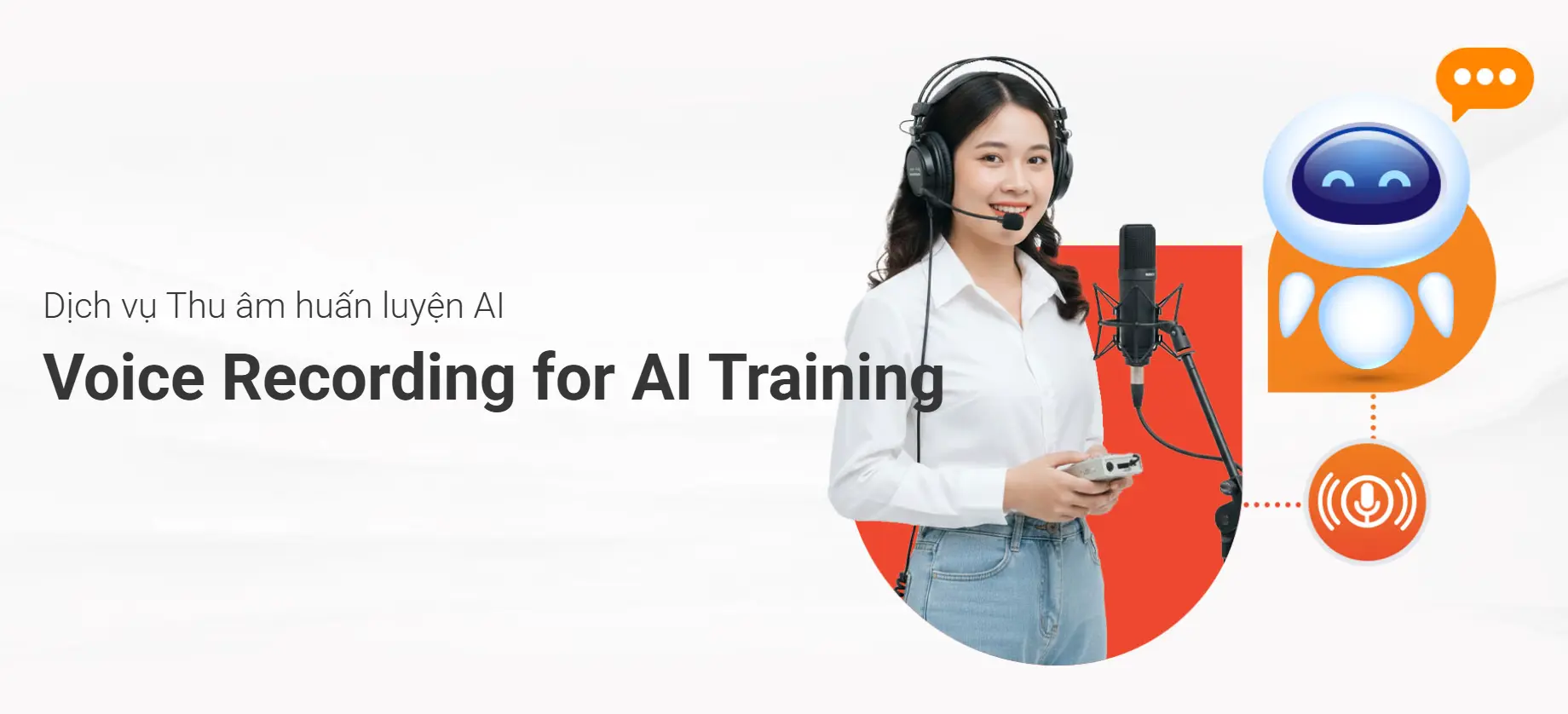
When the volume and complexity of the project exceed internal capabilities, partnering with an organization with experience in operating large-scale recording facilities helps shorten the implementation time and ensure consistency in quality. BSV provides AI training recording service With a team of more than 4,000 speakers nationwide, a 6-step process from requirements analysis to delivery, and a 3-layer QA system for each recording file.
For projects that require additional labeling steps after recording, BSV also has AI data labeling and annotation service To close the pipeline from raw data to data ready for training the model. The selection of the appropriate partner also needs to be based on specific criteria, which are analyzed in more detail in the article. How to choose an AI training company.
Business impact and indicators to monitor
Proper investment in voice collection has a significant impact on the effectiveness of AI projects. The implementation time is shortened because there is no need to build a speaker team and recording infrastructure from scratch.
The accuracy of the model improves when the input data is sufficiently diverse and consistently labeled, as demonstrated by the decreasing recognition error rate (WER) over training rounds. In terms of cost, project-based or speaker-based outsourcing models are typically more optimal than maintaining an in-house team solely dedicated to a data collection phase.
Conclusion
Collecting voice data for AI is not simply recording voice, but a process with its own technical standards, speaker size, and quality control, which directly affects the effectiveness of the AI model in the future. Choosing the appropriate collection method for each case while ensuring criteria regarding data diversity and legal compliance is a fundamental step before expanding the project scale.
Bellsystem24 Vietnam can support businesses in building high-quality voice data sets for AI projects, from scripted recordings to natural conversations and field data. Contact the consulting team:
- Hotline: 1900 1739
- Email: contact@bs24vietnam.vn
- Form for receiving advice