
What is a Voicebot?
Voicebot It is an artificial intelligence (AI) application software capable of communicating with users through voice. Voicebot can listen, understand, and respond in natural speech without the intervention of humans.
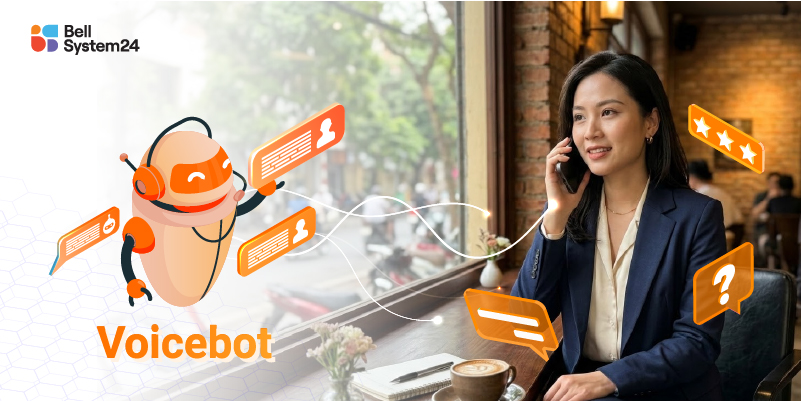
Unlike traditional automated systems that only read one-way messages, Voicebots can maintain a real conversation: from asking questions, processing responses, and performing specific tasks based on the content of the conversation.
The application of Voicebot
Used extensively in call centers Contact Center, Voicebots are typically deployed to receive inbound calls, make automated outbound calls, or serve as the first layer of processing before transferring calls to agents when necessary.
Currently, generally speaking, the tasks of voicebots are mainly handling repetitive, large-scale, and low to medium complexity operations.
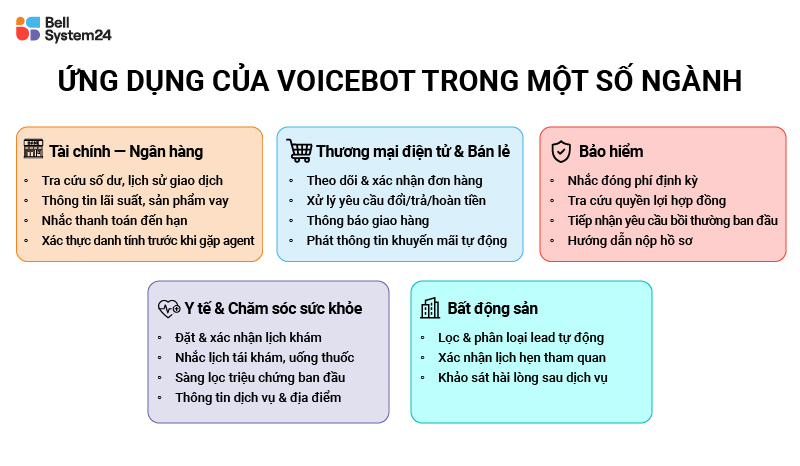
Here are some applications of Voicebot that Bellsystem24 Vietnam often chooses to deploy in the projects Contact Center.
Distinguish Voicebot from confusing concepts
Voicebot vs traditional IVR
This is the most important difference that needs to be understood.
- IVR (Interactive Voice Response) operates according to a fixed menu (Press 1 to hear account information, press 2 to speak to an operator) and can only receive keypress commands or pre-programmed phrases.
- Voicebot does not require customers to follow a fixed menu. Customers speak naturally, for example: “I want to check the order number 12345 that was delivered,” and the Voicebot understands the intention and processes the request.
Voicebot vs Chatbot
Both are based on AI and NLP (natural language processing), but differ in the interaction channel.
- The chatbot operates on text (websites, messaging apps, Zalo, Facebook Messenger).
- Voicebot operates on the voice channel (phone, applications with voice functionality).
Some modern platforms allow both to be deployed in parallel from the same AI engine.
Voicebot vs Callbot
Callbot is a specialized form of Voicebot, designed specifically for the telephone channel. Technically, it is almost identical, but Callbot is more commonly used to describe automatic call application by list (outbound), while Voicebot covers both inbound and outbound and on more devices.
How does a Voicebot work?
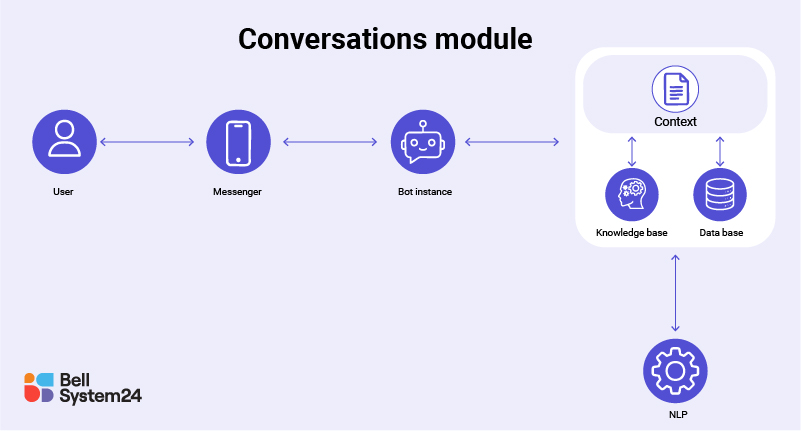
For a conversation between a customer and a Voicebot to take place naturally and accurately, the system needs to perform four consecutive processing steps in real time:
Step 1: ASR (Automatic Speech Recognition)
The customer's voice is converted into text. This is the foundation step for the entire process; if ASR recognition is incorrect, subsequent steps will be handled on the incorrect data.
Note: The quality of ASR depends heavily on the ability to handle regional accents, background noise, and the user's speaking speed. With Vietnamese – a language with melodic tones and diverse regional accents, this is the biggest technical challenge that Voicebot providers need to address.
Step 2: NLU (Natural Language Understanding)
The newly converted text will be analyzed to determine intent (intent) and entity (entity) in the sentence.
For example, with the sentence “I want to cancel the order placed yesterday”, NLU recognizes the intent as “cancel the order” and the entity as “time = yesterday”.
This is the core intelligence layer that distinguishes Voicebot from IVR, the ability to understand meaning rather than just matching keywords.
Step 3: Logical processing and data retrieval
Based on the identified intent and entity, the system performs the corresponding tasks:
- Searching for information from CRM
- Check the order database
- Update status
- Send a notification.
This is the step of integration with the enterprise's backend system; the quality of integration at this step determines whether the Voicebot will actually operate effectively or just provide general information.
Step 4: TTS (Text-to-Speech — Voice synthesis)
The answer is synthesized into natural voice and played back to the customer. TTS technology Modern technology has come a long way compared to the rigid robotic voice of traditional IVR.
This entire loop occurs continuously throughout the conversation, processing each customer’s utterance until the issue is resolved or the call is transferred to the operator.
Benefits of Voicebot
24/7 continuous operation
This is the most direct and obvious benefit. Voicebots have no working hours, no holidays, and are not affected by peak hours.
In industries such as finance, e-commerce, or healthcare, where support needs can arise at any time, this difference has a direct impact on Experience and level of satisfaction.
Handles multiple calls at once
An operator can only handle one call at a time. Voicebots have no limit.
During peak times, the number of calls can spike many times over normal levels. With a purely human system, that means long wait times and customers hanging up the phone. Voicebots absorb all that traffic without increasing wait times.
Reduce operating costs per call
The cost of handling a call by a call center agent includes salaries, training, management, infrastructure, and turnover rates. The cost of handling the same call by a Voicebot after accounting for the initial investment depreciation is always significantly lower, especially when calculated on a large scale.
For Contact Centers with 60–70% call volumes that are simple and repetitive requests, the optimal cost potential from Voicebots is very specific and calculable.
Consistent quality of service
The agent has good days and bad days. The Voicebot doesn't have that problem; each call receives the same quality of handling, the same tone, the same patience.
For businesses that operate large teams and have difficulty controlling the quality of each interaction, this is a real value-added advantage. service quality management.
Convenient for data analysis
All calls to the Voicebot are recorded and can be analyzed: what questions customers ask the most, which questions the Voicebot hasn’t yet handled, the time of day with the highest traffic, which customer groups call about what. This is valuable data for improving products, processes, and overall service quality.
The Liberation Agent focuses on the real issues that people need.
When Voicebot handles the vast majority of simple and repetitive requests, the agent has more time and energy to handle truly difficult situations that require empathy, judgment, and flexibility.
Which businesses are suitable to deploy Voicebots?
Voicebots create the most value when a business meets one or more of the following conditions:
- There are large numbers of inbound calls, and most of them are high-repeat requests
- Need to support customers outside of business hours but don't want or be able to maintain a 24/7 shift
- The cost of call center personnel is growing faster than revenue and needs to be optimized.
- Wanting to expand the Contact Center scale but unable to recruit and train agents fast enough to keep up with the growth
- There is a large list of customers that needs to be contacted on a regular basis.
Conversely, Voicebot not suitable yet or need to be considered more carefully in certain situations:
- The product/service is too complex
- Target customers are highly sensitive to technology (the elderly and high-end customers expect personalized service)
- The company does not yet have a data infrastructure that is sufficiently good for the Voicebot to integrate and retrieve accurate information.
Things that need to be carefully evaluated before implementation
Many businesses have high expectations when investing in voicebots, but ultimately do not achieve the desired results. According to Bellsystem24 Vietnam, the decision to invest in Voicebot should be based on realistic assessments, not just on impressive figures in the demo.
Here are the 4 most important factors that businesses need to carefully check with their suppliers:
- Real-world language recognition quality: The ability to accurately recognize the language of the voicebot must ensure diversity in pronunciation, intonation, and environmental conditions. For example: It is necessary to require testing with voices from the South, Central regions, people who speak quickly, and people of various ages in noise-filled environments.
- Ability to integrate with existing systems: Voicebot is only useful when it can access real data. It is necessary to ensure that the API is compatible with CRM, order management systems, customer databases, or existing business software.
- Handover mechanism to the agent: A good Voicebot isn't one that never takes a call, but one that knows when to take it. when Need to transfer and transfer smooth with full context so the agent doesn't have to ask again from the beginning.
- The roadmap for improving the bot after deployment: Like other AI algorithms, voicebots are not perfect from the beginning; they need to be monitored, analyzed, and continuously improved. Does the provider support this process?.
See also: AI Training – Guidance and Tips for Businesses
The process of deploying Voicebots in Contact Center
Successful implementation of Voicebot does not start with the selection of technology, but rather with a thorough understanding of the operational problem to be solved. Here is a 6-step process that successful implementations typically follow:
Step 1 — Analyze the traffic and categorize the current calls: Before doing anything, it is necessary to understand the current call volume and the characteristics of the call to assess whether it is appropriate to deploy a voicebot.
Step 2 — Determine the priority use case: Do not try to automate everything in the first deployment. Choose 2–3 use cases that have the highest frequency of usage, low complexity, and have sufficient data for the Voicebot to handle. Small successes will build the foundation and trust to expand to more complex use cases.
Step 3 — Design the dialogue script: This is a step that requires a combination of knowledge of customer behavior and conversational flow design skills. The scenario should include both the happy path (when everything goes as planned) and the handling branches for when the customer asks outside the scope, answers ambiguously, or requests to meet a real person.
Step 4 — Integration with the backend system: Connect Voicebot to CRM, order management systems, customer databases, and related systems. The quality and stability of the integration at this stage determines the vast majority of the actual value of Voicebot after go-live.
Step 5 — Testing and adjustment: Test with multiple scenarios, different voices, and different expressions for the same requirement. Collect feedback from internal teams before expanding to real customers.
Step 6 — Continuous measurement and optimization: After go-live, closely monitor the following indicators: the rate of calls fully handled by the Voicebot (containment rate), the rate of customers requesting an agent, satisfaction point after the automated call, and questions that the Voicebot often cannot handle. This data is the input for improving the scenario and expanding the processing capabilities over time.
Voicebot is just a tool, not a miracle.
Voicebot is not a magic solution that can completely replace humans in customer care. It is a powerful tool when deployed in the right situation, with the right process, and with enough data to operate effectively. When used appropriately, Voicebot not only optimizes costs but also improves the overall quality of service.
For businesses that are operating or planning to build Contact Center, Voicebots are increasingly becoming an indispensable part of architecture. modern customer service, Not because it is a technological trend, but because the operational problem it solves is a real problem that most businesses are facing.
Get advice from Bellsystem24 Vietnam
If you are evaluating the implementation of Voicebot and would like to learn about it from a practical operational perspective, the Bellsystem24 Vietnam team with 19 years of experience in operating inbound services and AI applications in Contact Centers is ready to assist.