
In the era of booming artificial intelligence, data labeling has become an important foundation for building accurate and efficient AI models. So, what exactly is data labeling, and why is it so crucial? Let’s explore in detail this key process with Bellsystem24 Vietnam.
What is Data Labeling?
Data labeling is the process of identifying, classifying, and tagging raw data to help machine learning algorithms understand and learn from that data. This is the important pre-processing step in data mining. Training AI models.

For example, when you want to train an AI model to recognize cat images, you need to provide thousands of images that have been labeled as “cat” or “not cat”. This labeling process is called data labeling.
In reality, data labeling can be applied to various types of data: images, text, audio, video, and many other complex data formats. The quality of data labeling directly influences the accuracy and performance of AI models.
Data labeling classification
Data labeling is classified in various ways based on the type of data and the intended use. Here are the most common classifications:
Image labeling
This is the most common type of data labeling in computer vision. Image labeling is the process of assigning structured information to images to help AI models understand and learn the content within those images. These labels serve as correct answers, helping AI recognize, categorize, or locate objects when trained.
The main methods include:
- Image classificationAssigning one or more labels to the entire image (for example: “landscape”, “portrait”, “animal”)
- Bounding boxDraw a rectangular frame around the object to be recognized.
- Polygon annotationDraw details around the object's shape
- Semantic segmentation: Classification of each pixel in an image
- Keypoint annotationMarking important points on the object
Text labeling
It is the process of labeling, tagging, or structuring information in text data to help AI models understand the meaning, context, and purpose of human language. This is the core step in training NLP (Natural Language Processing) systems using the supervised learning method.
The main methods include:
- Text classificationLabeling the entire text according to a theme, emotion, or intention
- Named Entity Recognition (NER)Identifying and classifying entities such as names, places, organizations
- Sentiment analysisEvaluating positive, negative, or neutral emotions
- Intent classificationIdentifying the purpose of the user in chatbots and virtual assistants
Audio Labeling
It is a structured labeling process for audio data (audio files, calls, voices, noises, etc.) to help AI models recognize, understand, and analyze audio content. This is a fundamental step for training Speech AI and Audio AI systems. This type of labeling is often used in voice recognition and audio analysis.
The main methods include:
- Speech-to-text transcription: Convert voice to text
- Sound classificationClassification of different types of sounds
- Speaker identificationIdentify the speaker in the recording
- Emotion detectionRecognizing emotions through voice
Video labeling
Combining image and audio labeling techniques with temporal elements to help the AI model understand the actions, objects, and dynamics of events in the video.
The main methods include:
- Object trackingTrack the subject moving through the frames
- Action recognitionRecognizing actions and activities
- Scene segmentationVideo segment by shot
Data Labeling Process
The Data Labeling process is a set of controlled steps that convert raw data into high-quality labeled data for training AI that is accurate, consistent, and deployable in a business environment.
The core point of the standard process lies in fast labeling, which is:
- Consistency
- Scalability
- Quality control
- Compliance with laws & privacy
Step 1: Determine the objectives and requirements
Before starting, it is necessary to clearly define the goals of the AI project and the specific data requirements. This includes:
- Determine the type of data to be labeled
- Definition of labels and classification criteria
- Evaluate the amount of data required
- Determine the level of accuracy required
Step 2: Collecting and preparing data
Not all data is suitable for labeling. Raw data collected from various sources must undergo cleaning and standardization processes to ensure quality. This step may include removing duplicate data, processing missing data, and ensuring the diversity of the dataset.
Step 3: Set up labeling rules
This is the rule for the entire team of annotators, ensuring that everyone understands the same labels. Detailed documentation helps ensure consistency during labeling. The documentation should include:
- Clear definitions of each type of label
- Specific examples of common cases
- How to handle ambiguous or difficult situations
- Common mistakes to avoid
Step 4. Training the labeling team
The annotator does not just “label”, but also data decision-makers. Businesses need to undergo proper training before expanding.
Basic training elements:
- Training in business culture, professional skills, and industry context
- Test your understanding and application of the labeling rules
- Run a small pilot before implementing a large one.
Step 5: Perform labeling
This is the central step of the process; the annotator team will label according to the guidelines, using the appropriate tools and with a log control system. At Bellsystem24 Vietnam, we use advanced labeling tools and a strict quality control process to ensure the highest accuracy.
Step 6: Quality check
Each labeled dataset undergoes a multi-layer verification process to ensure accuracy. If the data is incorrect, the model will learn incorrectly, and even the errors will spread through the domino effect.
Typical testing methods:
- Peer reviewLabeling staff check each other
- Quality control team: The dedicated team checks random samples
- Consensus labelingMany people label the same sample to compare the results.
- Inter-annotator agreement: Measuring the consensus
Step 7: Train and evaluate the model
The labeled data will be used to train the AI model. During that process, the developer will continuously evaluate the impact on the model; the actual results of the model help assess the labeling quality and identify areas for improvement.
Step 7: Repeat and optimize
Based on feedback from the AI model, the labeling process is continuously adjusted and improved to improve quality.
Data Labeling Methods
There are many different methods for performing data labeling, each with its own advantages and disadvantages. They vary in terms of automation level, cost, accuracy, and scalability. No method is “best for all cases”; it only depends on the specific stage of AI development.
Manual labeling
This is a traditional method where human beings directly label each dataset based on guidelines. This is the most accurate method, especially for complex data.
Advantages:
- Highest accuracy for complex tasks
- Flexible handling of special cases
- Suitable for data requiring deep professional knowledge or emotional requirements.
Disadvantages:
- Time-consuming and expensive
- Limited scalability potential
- There may be deviations due to human factors.
Automated labeling
Use available AI algorithms and models to automatically label data.
Advantages:
- Fast processing speed
- The cost is much lower than manual labeling
- Easy to scale up
Disadvantages:
- Lower accuracy, especially with complex data
- A well-trained AI model is needed
- Difficult to handle exceptional cases
Semi-Automated Labeling
Combining the power of technology and human labor: The machine performs the preliminary labeling, while the human checks and adjusts. This is the optimal way to balance speed and quality.
Advantages:
- Balance between speed and accuracy
- Cost optimization
- Allows processing large volumes of data with high quality
Disadvantages:
- Requiring complex tools and processes
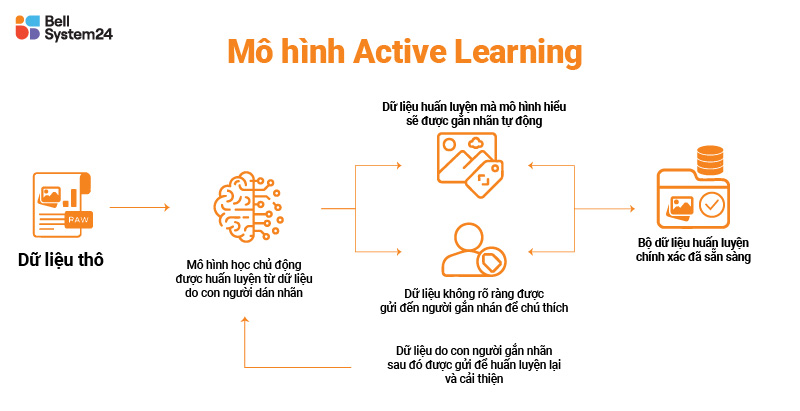
Active Learning
The AI model proactively selects difficult or confusing data samples for human labeling first, while the AI learns only those data samples that the model is sure to understand, optimizing the learning process.
Advantages:
- Significantly reduces the amount of data that needs to be manually labeled
- Improving the training efficiency of the model
- Focusing resources on the most important data
Disadvantages:
- Requirement for close integration between labeling process and training
- It needs an initial basic model
Crowdsourcing
Distribute labeling tasks to a large community of participants through online platforms.
Advantages:
- Rapid scale-up
- Low cost
- Diversity of viewpoints
Disadvantages:
- Quality control is difficult
- Strict mechanisms are needed to ensure reliability.
- Not suitable for sensitive data or highly specialized requirements
Ways to minimize errors when labeling data
Bias in data labeling occurs when the data labels do not accurately reflect the overall reality, causing AI models to learn incorrectly, make erroneous predictions, and create business, legal, or ethical risks. This is a common cause of failure in the implementation of many enterprises' AI projects.
It is necessary to understand that the error does not come from AI, but from:
- The quality of the data collected
- The way humans label things
- The process and initial assumptions
Therefore, to minimize errors in data labeling, it is necessary to pay attention to the following points:
Ensure the data represents the whole
If the input data is skewed, standard labeling won’t save the model. To achieve this, experienced businesses often collect data from multiple sources, covering multiple user groups, contexts, and time periods. The goal is to ensure the input data is sufficiently large, diverse, and representative of the overall population, without bias.
Develop instructions for labeling in detail and clearly
The instruction manual should be carefully designed with specific examples, including borderline and ambiguous cases. The manual should be updated regularly based on new situations that arise during labeling.
Training and calibration of labeling specialists
Organize regular training sessions and competency checks for professionals. Conduct tests to ensure that everyone understands and applies the labeling standards consistently.
In addition, businesses can build a carefully labeled sample dataset used as a standard to evaluate and train new labeling professionals.
Using multiple sources of labeling
Each dataset is labeled by different people, who then use consensus methods or majority voting to decide on the final label. This helps minimize individual bias.
Diversify the labeling team
Building a team of professionals from different backgrounds, ages, genders, and cultures. This diversity helps to reduce unconscious biases that can affect the labeling process.
Multilayer quality inspection
Establish a multi-layered quality control process with specific measurement metrics such as Inter-Annotator Agreement (IAA), Kappa score, and F1 score. Determine the minimum quality threshold and discard data that does not meet the standard.
Using the smart labeling support tool
Modern labeling tools can alert on inconsistent patterns, suggest labels based on similar data, and provide automatic testing features. This helps detect and fix errors early.
Continuous analysis and monitoring
Regularly analyze labeling results to detect systematic patterns of errors. Use statistical and visualization tools to track trends and identify potential issues.
Analyze the errors of the AI model after training to identify potential issues in the labeled data. Use this information to improve the labeling process and guidelines.
Data labeling outsourcing service
When large-scale data labeling is needed, many businesses have chosen to outsource it to optimize costs and time. Here are the benefits to consider when choosing this service.

Benefits of outsourcing data labeling
Significant cost savings
Instead of investing in building internal teams, tools, and infrastructure, businesses only need to pay for the actual services used. Labor costs in Vietnam are much more competitive compared to developed markets.
Flexible scale expansion
Professional BPO partners are capable of quickly adjusting their workforce size according to project needs, ranging from a few hundred to thousands of samples of data per day.
Focus on core competencies
Businesses can allocate resources to developing AI algorithms, research, and business strategies instead of managing the data labeling process.
Expertise and in-depth experience
Professional service providers have teams that are well-trained and experienced in handling various types of projects, from computer vision to NLP.
Ensuring high quality
Multilayer quality control processes and dedicated tools help ensure the accuracy of labeling data.
Why choose Bellsystem24 Vietnam?
Bellsystem24 Vietnam We are the leading provider of BPO and AI data training services in Vietnam. We are proud to offer Comprehensive data labeling solution with outstanding advantages:
Top-notch team of experts
Over 4000 highly trained professionals with experience handling a wide range of data types from images, text to audio and video. Our team is proficient in multiple languages and capable of handling international projects.
International standard process
We apply a 6-tier quality control process with an accuracy of up to 98-99%. We comply with ISO standards and have international security certificates, ensuring that your data is always protected absolutely.
Advanced technology
Using the latest data labeling tools combined with AI support, it helps increase productivity while ensuring high quality. The online project management platform allows customers to track progress in real time.
Extensive experience
We have successfully completed many projects for clients from the fields of technology, fintech, e-commerce, and many other industries. We understand the specific requirements of each industry and have optimal solutions.
Flexible and quick
The ability to deploy the project within 72 hours and expand the scale as needed. We work 24/7 to meet the most stringent deadlines.
Competitive costs
Reasonable pricing with guaranteed quality helps customers save up to 60% costs compared to building an in-house team or outsourcing it in other markets.
Commitment and support
Our dedicated account managers support the project throughout its lifecycle. We are committed to meeting strict SLAs and have a clear quality warranty policy.
Bellsystem24 Vietnam is committed to accompanying businesses on their digital transformation journey and AI development. With our experience, expertise, and leading technology, we are confident to provide the most optimal data labeling solution for all business needs.
Contact us today for advice →