
In an environment Call center Modern, high-quality calls not only reflect the capabilities of the operator but also directly determine the brand image and customer loyalty. That is why call quality management has become an indispensable part of any business’s call center operations strategy.
This article will help you understand what call quality management is, why it is important, how to implement it properly, and the specific evaluation criteria for each type of inbound and outbound call.

What is a call QA?
Call QA (Call Quality Assurance) is the process of monitoring, evaluating, and Improving the quality of calls in Call Centers. The goal of call QA is not only to score each conversation, but also to identify system issues, standardize service delivery, and continuously improve. improving the customer experience.
In fact, call QA involves many activities that are closely related to each other:
- Listen to the recording again
- The grading is based on predefined criteria.
- Analyzing the root cause when there is a mistake
- Direct feedback to the operator through training (coaching).
Among the Modern Call Center system, QA is also supported by voice analytics and artificial intelligence technology — which helps automatically evaluate 100% calls instead of just taking random samples as is traditionally done.
Why should the quality of the call be evaluated?.
Enhance customer experience and consistency
Customers call the help desk at different times, with different agents, but they expect to receive the same level of service. Call quality management helps businesses detect and eliminate these inconsistencies, ensuring that every time a customer contacts them, it is a positive experience.
Strengthen customer retention
The cost of acquiring new customers is much higher than retaining existing customers. Call Center managers understand this reality and that is why it is necessary to ensure the quality of calls to customers to avoid them switching to using the services of competitors.
Infrastructure for training and developing the team
QA results are not just the numbers in the report; they are Real data reflects the capabilities of each dispatcher. The supervisor can use this to identify who needs coaching on handling rejection skills, who needs to improve their listening skills, and who is performing excellently and should be rewarded. The QA data also helps the training department design the training. program to enhance customer experience more closely aligned with operational reality.
Create a distinct competitive advantage
For businesses with high call volumes, response speed and processing quality are the most distinct differentiating factors compared to competitors. A robust call center software combined with a well-structured QA process will help businesses operate smoothly, increase the rate of resolving issues from the first time, and create a real difference in the customer experience, which is something that competitors with no serious QA system find it difficult to match.
Standard call QA process
An effective call QA process should not stop at the “listening and scoring” step. To create real improvements, the process needs to be designed in a continuous loop with the following 5 core steps:
Step 1 — Develop a scoring system (Scorecard)
Before starting any evaluation activity, businesses need to clearly define what “good quality” means. The scoring system must reflect the business objectives and the specific characteristics of each type of call (Inbound or Outbound), customer care or sales. Each criterion should have a weight.,
- For example, compliance with the complaint handling process can take up a higher proportion of time than simply greeting someone with the correct form.
Step 2 — Collect and select a call sample
Depending on the size and existing technology, businesses can implement it in two ways (or in combination):
- Method 1: Select a random sample of a certain percentage of the total number of calls recorded,
- Method 2: Alternatively, apply automatic analysis to all 100% calls.
The second approach is becoming increasingly common thanks to WHO, It is particularly effective in detecting calls that are high risk and require priority review.
Step 3 — Evaluation and scoring
The QA Analyst listens to the recording (or views the automatically converted transcript) and scores it according to the established scorecard.
This step requires high consistency — for the same call, two different QA Analysts need to agree on the similarity. Therefore, serious businesses often organize regular calibration sessions to ensure consistency in the understanding and application of the criteria.
Step 4 — Feedback and coaching
The evaluation results need to be translated into action. The supervisor or QA lead should have a direct feedback session with each agent, not only pointing out errors but also explaining why they are a problem and guiding how to improve them specifically.
Learn more: Training course on coaching skills intensive
Step 5 — Continuous monitoring and improvement
Call quality management is only truly valuable when data is aggregated over time, analyzed for trends, and fed back into the process improvement loop.
QA indicators need to be reviewed periodically, weekly or monthly to assess the effectiveness of training interventions and to detect early problems that arise.
The quality assessment criteria for the call.
Not all businesses have the same QA criteria; this is perfectly reasonable given the different business goals and industry specifics. However, there are a number of common criteria that most call centers need to consider, divided into two main categories of calls.
QA criteria for inbound calls
Inbound calls are calls from customers who may need technical support, answer questions, handle complaints, or simply learn about product information. With this type of call, QA metrics typically focus on response speed, quality of problem resolution, and satisfaction levels.
- Service level
Service Level = [Number of calls answered within the set threshold] / [Number of calls provided] x 100.
Service Level It indicates the level of accessibility of the Call Center to customers and the performance of the agents providing services. Service Level provides a a holistic view of the customer experience and call center performance.
- First contact resolution
First contact resolution = (problem solved in the first call/ total number of problems encountered from the customer) x 100
It is an indicator that shows the resolution from the business from the very first time the customer makes a call to the call center. It is calculated as a percentage.
If customers know that they can receive satisfactory answers without wasting much of their time, they will be more satisfied with your service. A service quality management study shows that for every 1% FCR increase, there is an improvement of 1% in CSAT (Customer Satisfaction Score).
- Average Handling Time (AHT)
Average Handling Time Time of speech + Time of waiting + Data processing time.
This criterion indicates the average time a call center agent needs to complete an interaction with a customer.
AHT helps businesses categorize agents based on their capabilities, thereby making the interaction with customers faster and more effective.
- Customer Satisfaction (CSAT)
Customer Satisfaction = (Total score / Number of survey respondents) X 10.
Measuring customer satisfaction is very important in planning to retain customers. On average, businesses lose half of their customers every year if they do not have effective strategies to identify and retain customers. Measuring customer satisfaction helps businesses have strategies to adjust and support customers through agents in the best way possible.
- Net Promoter Score ( NPS )
Net Promoter Score = % (Promoters) – % (Detractors)
It is a measure of customer satisfaction and the degree to which customers are willing to continue using the product/service and recommend it to others.
The main purpose of using this criterion is to find the correlation between what customers answer in the survey and the actual growth of the business afterwards.
QA criteria for outbound calls
Outbound call These are calls made proactively by agents to sell products, provide after-sales support, conduct surveys, schedule appointments, or introduce new products/offers. With outbound calls, the QA criteria need to reflect both the effectiveness of the approach and the quality of the conversation content.
Call Abandonment Rate (Call abandonment rate)
Formula: Call Abandonment Rate = ((Number of calls made − Number of calls received) / Number of calls made) × 100
This is the percentage of calls where customers hang up before being connected to the operator. This high rate is often due to long wait times., IVR system Unclear, or the operator is not equipped to handle it. By industry standards, a ratio of 2–5% is considered acceptable. If this exceeds this threshold, businesses should review their call flow structure and staffing capacity during peak hours.
Average Time on Hold (Average waiting time)
Formula: Average Time on Hold = Total time the phone is held for all calls / Number of calls processed
No one likes waiting, and in the Outbound context, a call where the customer has to hold the phone for too long can easily turn into a negative impression. Research shows that 60% customers consider waiting even a minute too long, and the majority are only willing to wait for a maximum of two minutes. This indicator needs to be monitored by time slot to coordinate the appropriate staffing.
Conversion Rate
For outbound campaigns with sales or feedback goals, conversion rate is an indispensable indicator. However, high conversion rates, accompanied by negative feedback later on, are still unsustainable results. Therefore, this metric should be combined with CSAT and NPS to ensure long-term quality.
Script & Compliance Adherence
Especially important in industries with high legal requirements such as finance, insurance, and healthcare, call center agents need to ensure that the call content is in line with the approved script, not provide misleading information, and comply with regulations on the protection of personal data. In this case, QA not only protects customers but also protects the business itself from legal risks.
Call Center QA software
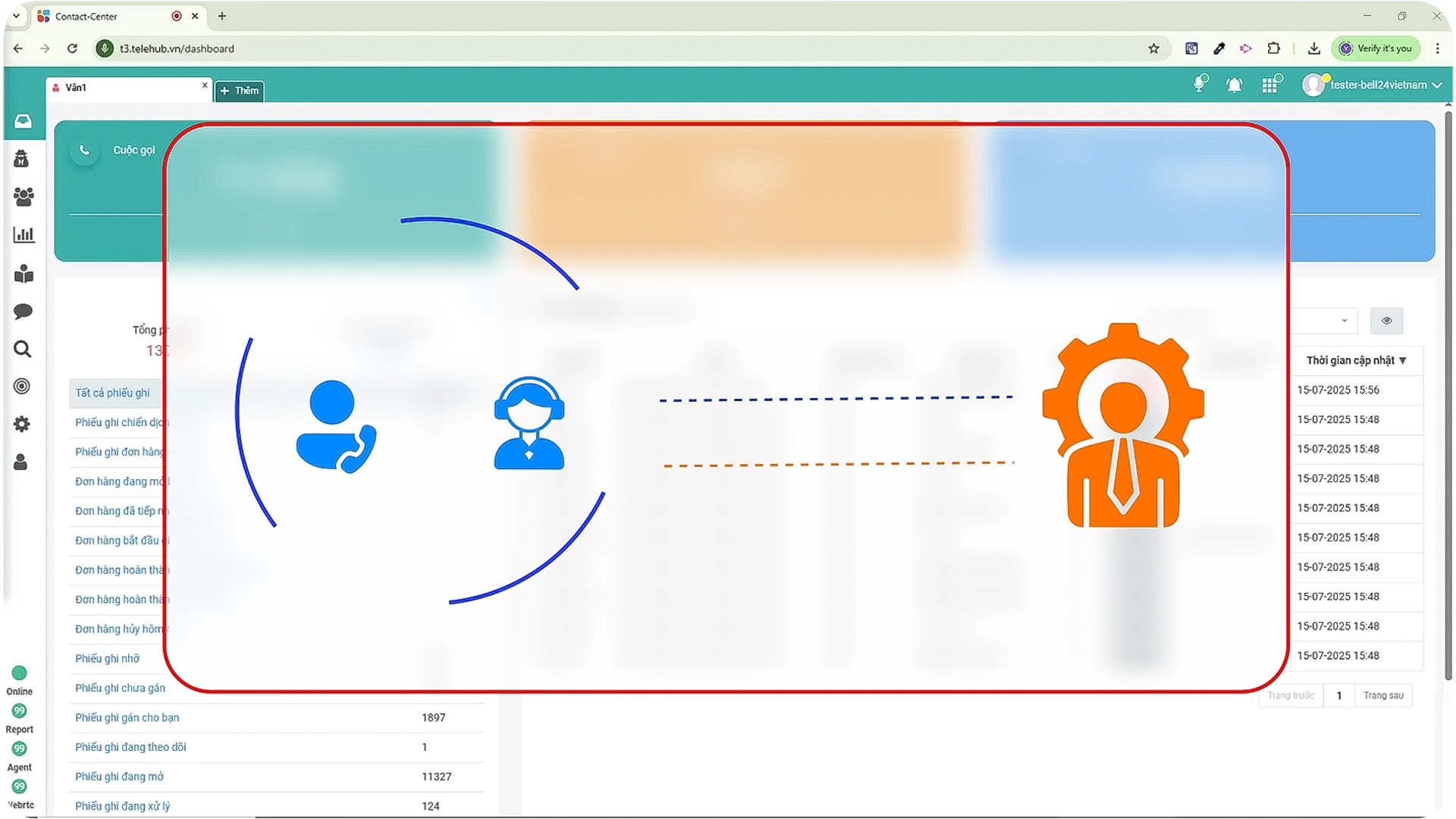
Traditional QA methods, which involve manually listening to each recording and filling out scoring forms, increasingly reveal their limitations. As the number of calls increases to thousands per day, no QA team can guarantee completeness and consistency if it relies solely on manual sampling. This is why modern QA software platforms are becoming an indispensable choice for call centers with an average size or larger.
New generation call QA software platforms often integrate the following core features:
- Record and store the entire call — with the ability to search by keyword, time, agent, or specific campaign group.
- Speech Analytics (Voice analysis) — AI technology converts voice into text and automatically labels calls based on sentiment, risk keywords, or non-compliant segments.
- Automatic scoring — instead of listening to each call, the system can automatically evaluate 100% calls based on pre-programmed criteria, then present a prioritized list for manual review by the QA Analyst.
- Dashboard and real-time reports — helps supervisors and managers monitor the quality of call performance right during the work shift, without having to wait until the end of the day or the weekend to get a report.
- Integration with the training system — some platforms allow for direct integration from the QA results into training modules, automatically suggesting the appropriate course for each agent based on their specific weaknesses.
It is important to note that QA software does not completely replace human resources; rather, it amplifies the effectiveness of the QA team and helps them focus on the things that truly create value: in-depth analysis, in-depth coaching, and process improvement. When combined with a efficient call center software, With automated QA systems, the performance of inbound and outbound processes can be significantly improved without increasing the corresponding number of QA staff.
Businesses are looking for a comprehensive Contact Center solution, including both operational infrastructure and QA processes — more information can be found here. Professional Call Center outsourcing solution, where the call quality assurance process has been standardized and operated stably through years of experience.
Conclusion
Call QA is not just a “checking exercise”; it is a system that helps businesses continuously learn from their real interactions with customers. When implemented seriously with clear criteria, consistent processes, and appropriate support technology, call QA becomes one of the most powerful levers for improving service quality, retaining customers, and building sustainable competitive advantage.
If you are looking to build or upgrade your Call Center's QA system, the Bellsystem24 team in Vietnam is ready to assist — from providing advice on the criteria set, to implementation. Contact Center solution Integrating modern technology.