
Telemarketing It is an indispensable activity in the business strategy of many businesses. It is not just a matter of making phone calls to persuade customers; behind those calls lies an entire operational system, the effectiveness of which depends greatly on how it is managed.
Have you ever felt stuck when your telesales team lacked motivation, the workflow was disorganized, or the performance did not meet expectations? If so, this article is the solution for you.

Understand the root causes of the problems
First, to improve efficiency, we must understand why telesales performance is not as expected.
- Lack of motivation to work: It is not always possible for call center agents to maintain a positive attitude. If the pay and benefits policy is unclear or unfair, or if efforts are not recognized, their enthusiasm will diminish.
- The process is unclear: A fragmented and unsystematic process will make the work team inconsistent. Each employee may create their own unique way of doing things, resulting in low efficiency.
- Getting the customer wrong: Not categorizing customers and not having a proper approach will make calls meaningless, wasting time and resources.
- Recruiting the wrong people and training them incorrectly.
- Lack of work support tools.
If the root cause cannot be determined, the manager will be ‘vague’ in resolving the problem thoroughly.
The process of determining the causes that reduce the effectiveness of telesales
Step 1: Collect real data
Before analyzing, make sure you have all the information and data related to the performance of the telesales team.
Data source:
- Report of revenue and profit
- Call recording
- KPI reports such as: Number of calls/day, conversion rate, average time to close a sale.
- Customer feedback (through surveys or direct evaluations).
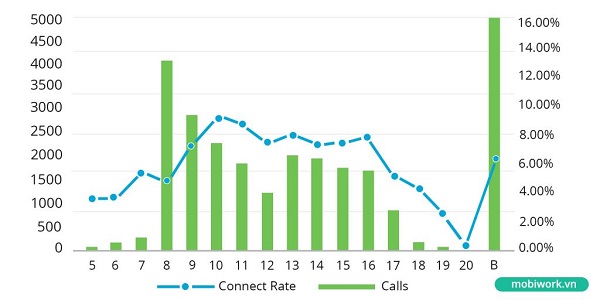 Example of the analysis table of connection rates by time frame
Step 2: Listen and observe the team
The data only reflect a partial aspect of the problem. Listening to and observing employees work directly will help you gain a deeper understanding of the cause.
How to do it:
- Observe how employees interact with customers through actual calls.
- Listen to the difficulties and pressures they share in their work.
Note: Create an open atmosphere so that employees feel comfortable sharing.
Step 3: Analyze the current problems
After gathering enough information, start analyzing to identify the specific issues affecting the team's performance.
Questions to be asked:
- Which stage of the call do agents often have difficulty with (reaching customers, handling objections, closing the sale)?
- What is the reason for the low conversion rate?
- Is there a problem with the telesale process or script?
- etc.
Step 4: Identify the root cause
This is the most important step to find the “root” of the problem instead of just solving the surface.
The 5 Whys method (5 questions Why?)
For example:
Problem: Low conversion rate.
- Why? Staff often cannot handle rejection.
- Why? Because they don't understand the real needs of customers.
- Why? Because there is no step to collect customer information before making the call.
- Why? Because the telesale process lacks a data preparation step.
- Why? Because the manager has not yet developed standard procedures and documents.
Classification of causes.
- Human causes: Lack of skills, motivation, or bad attitude.
- Process reason: Unstandardized, fragmented, or unclear.
- Technological reasons: There is no support tool, or the tool is not suitable.
Once the root cause has been identified, the next step is to build and implement the appropriate solution to improve the effectiveness of telesales.
Building a strong telesales team from the ground up
To build a strong team, you need to start with hiring, training, and maintaining the motivation of employees.
- Recruiting the right people: Don't just choose candidates with experience; choose those with a positive attitude, good communication skills, and the ability to handle pressure. A mock interview situation will help you identify who is the right person for the job.
- Continuous training: Training should not just take place in the first few weeks; it should be a long-term process. Regularly organize role-play sessions, invite experts to share rejection handling skills, and continuously update team members on product knowledge.
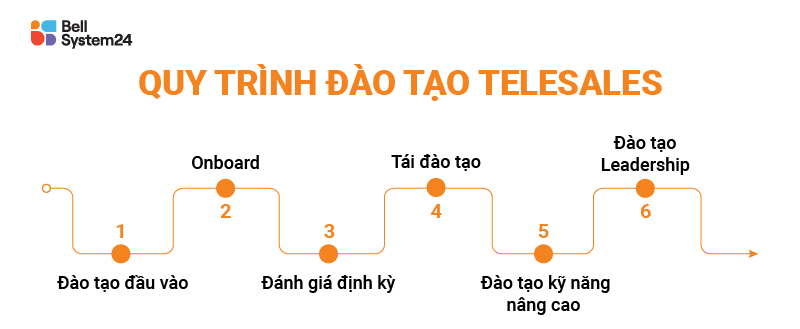
The telesales training process at Bellsystem24 Vietnam usually includes:
- Encouraging spirit: Everyone wants to be recognized. Set clear, realistic goals and provide them with deserved rewards when they achieve them. Additionally, organizing competitions or activities to recognize achievements will help build a sense of unity and motivation among the team.
- Maintaining a balance between pressure and motivation working It is the secret that keeps telesales moving forward.
Optimizing the process to improve the effectiveness of telesales
Processes are the backbone of all operations. A good process not only increases work efficiency but also minimizes errors that may arise.
- Process standardization: Clearly outline the steps from customer outreach, product presentation, to handling rejection and closing the sale. Each step must be defined specifically so that employees can easily perform it.
- Building a professional telesale script: A script is not just a piece of paper to be read by heart. It is a tool that guides employees in leading a flexible conversation, asking open-ended questions, and skillfully handling rejection. A good script should be divided into groups based on each customer segment.
See also: Effective telesales script template
- Managing time effectively: Don't waste time on prospects that aren't ready to buy. Use data to segment your customers and focus on the groups with the highest conversion potential.
Using modern support tools to increase the effectiveness of telesales
Technology is an indispensable companion in telesales operations. The right tools can save time, increase accuracy, and improve performance.
- CRM (Customer Relationship Management): Store and manage customer data in a scientific manner, track the history of communication, and remind about the next calls.
- Auto callCall automation software. Automatic dialing, which reduces wait time and optimizes the number of calls during the day.
- KPI measurement tools: Track team performance in real time, helping you identify problems quickly.
Evaluating the effectiveness of telesales and continuously improving it
Telemarketing management is not a “one-time thing”. You need to constantly evaluate and improve.
- Set clear KPIs: Measure metrics such as the success rate of calls, conversion rates, and the average time to close a sale. These are factors that accurately reflect the effectiveness of the work.
- Data analysis: Take the time to read and understand the data. The data not only tells you what is happening, but also explains the reasons and how to fix it.
- Learn and continuously improve: Organize regular meetings to review results, share experiences, and apply necessary adjustments. Don't hesitate to experiment with new approaches such as A/B Testing to find the optimal strategy.
Improving telesales efficiency is not an easy journey, but with thorough preparation, a strict process, and modern support tools, you can turn every challenge into an opportunity. Start today – standardize your processes, invest in your team, and continuously improve. Success doesn’t come from big changes once, but from small, but steady steps every day.