
SIP Trunk is a solution that replaces traditional voice telephony infrastructure (PSTN) with an Internet connection; this solution is used in most companies. Modern Contact Center. This article will explain what a SIP trunk is, how it works, when to deploy it, and what to keep in mind for businesses.
What is SIP Trunk?
SIP Trunk (or SIP Trunking) is a technology that allows businesses to make and receive voice calls over the Internet instead of using the traditional physical telephone line (PSTN). Its name is derived from two components:
SIP — Session Initiation Protocol: The signaling protocol used to initiate, maintain, and terminate multimedia communications sessions, including voice, video, and IP messaging. SIP is the most widely used standard protocol in VoIP system currently.
Trunk: The connection line carries multiple signals simultaneously. In traditional telecommunications, a physical trunk is a pair of copper wires or fiber optic cables connecting the PBX to the public telephone network. SIP Trunk replaces this physical connection with an virtual connection over the Internet.
Put simply, instead of a business needing 50 physical phone lines to handle 50 calls simultaneously, SIP Trunk allows that number of calls to be handled over a single Internet connection, with much lower costs and more flexible scalability.
How does SIP Trunk work?
The process of a call passing through SIP Trunk goes as follows:
Step 1 — Initiate the call
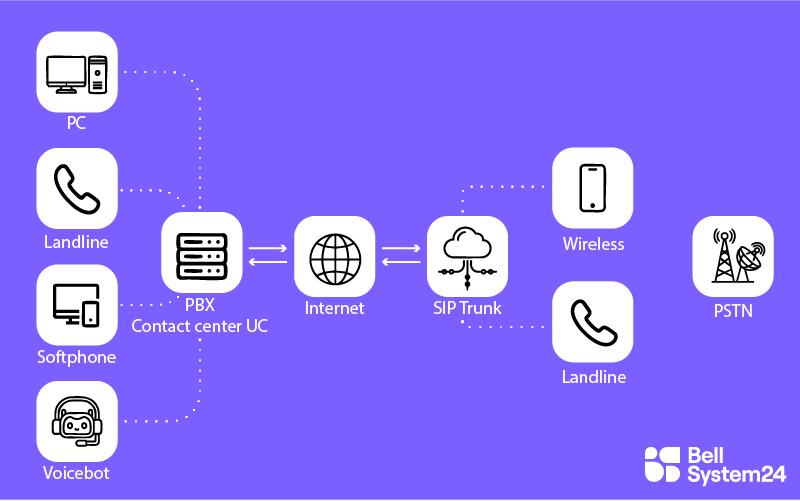
When the agent or customer starts the call, the company's IP-PBX (internal telephone system) sends a SIP signal to the SIP Trunk provider over the Internet.
Step 2 — Routing
The SIP Trunk provider receives the signal, identifies the destination number, and routes the call to the correct point, which can be a public switched telephone network (PSTN), a mobile network, or another VoIP endpoint.
Step 3 — Voice transmission
The voice is digitized and compressed using standard codecs (G.711, G.729…) and transmitted over the Internet as IP data packets in the same way as conventional data transmission over the Internet.
Step 4 — Conclusion and recording
When the call ends, the SIP protocol sends a session termination signal, the system records the duration, and updates the report.
There is an important point to understand: a SIP Trunk can handle multiple calls simultaneously; the number depends on the subscribed bandwidth and the number of licensed channels. This is a fundamental difference compared to traditional physical lines, where one line can only handle one call at a time.
SIP Trunk vs. PSTN
To fully understand the value of SIP Trunk, it is necessary to compare it directly with the PSTN model that most businesses are currently using or have used in the past.
| Criteria | PSTN | SIP Trunk |
|---|---|---|
| Infrastructure | Wiring, fixed hardware | Internet connection |
| Cost of shipping | High | Lower, call the domestic network for free |
| Expand | It is necessary to install additional physical lines. | Add channels via software configuration |
| Location | Connected to the installation location | Working remotely with the Internet |
| Integration | Restrictions | Flexible |
The benefits of SIP Trunk for business operators of Contact Centers
Significantly reduce voice infrastructure costs
This is often the first and most obvious reason for businesses to switch to SIP Trunk. The cost of local calls between branches is usually zero, as the signal travels only within the internal network.
For calls made outside the country, especially interprovincial and international calls, the cost is also significantly lower than PSTN charges. Additionally, there is no longer any cost for maintaining the physical line, connecting hardware, and periodic maintenance.
Instant scale-up without installation required
With traditional PBX systems, adding 20 new lines means scheduling with the provider, waiting for installation, which can take time. With SIP Trunk, simply configuring the software is all that is required, and it can be done in minutes.
With the Contact Center Inbound There is seasonal or campaign-based flow variability; this is a direct operational advantage.
Support for remote work
SIP Trunk is not tied to a physical location. Agents can work in Hanoi, Ho Chi Minh City, or remotely, all connected to the same system, the same number, and the same queue. With the current hybrid work trend, this is a basic technical requirement rather than an advanced feature.
Flexible integration with other systems
SIP Trunk is an open protocol that is compatible with most IP-PBX, call center software, and CRM systems on the market. This enables the creation of an integrated ecosystem that allows call data to be synchronized with CRM, and interaction history displayed directly on the agent's screen, with real-time reports from a single data source.
Better redundancy and greater stability
The modern SIP Trunk system allows for automatic failover configuration: if a connection line fails, calls automatically switch to the backup line without interruption. This is a capability that traditional PSTN infrastructure cannot achieve in a flexible and immediate manner.
SIP Trunk in the modern Contact Center environment
For businesses operating medium-sized and large Contact Centers, SIP Trunk is not just a cost-saving solution; it is the technical platform that enables many important operational features to operate.
Integrates with IVR and ACD: SIP Trunk integrates with the system IVR (Interactive Voice Response) and ACD (Automatic Call Distribution) enables intelligent routing. Each incoming call is classified, initially processed by the IVR, and routed to the appropriate agent or processing team, all automatically and with flexible configuration options.
Combined with Voicebot and AI: Solutions Voicebot And current voice automation works on the SIP platform. When deploying a Voicebot to handle inbound calls automatically or perform outbound calls automatically, the SIP Trunk is the infrastructure layer that connects the Voicebot to the actual phone network.
Support for a wide range of numbers: Through SIP Trunk, businesses can connect and operate multiple types of numbers simultaneously: 1800, 1900, fixed numbers, mobile numbers.
The foundation for omnichannel: SIP Trunk is the voice platform within the architecture Omnichannel Contact Center. When the voice channel is standardized on SIP, integrating it with other channels (chat, email, social media) to create a unified interaction management system will be much more convenient.
Things to consider before deploying SIP Trunk
Internet bandwidth
The quality of a SIP call depends directly on the bandwidth and stability of the Internet connection. Each call simultaneously consumes about 85–100 Kbps (depending on the codec). A call center that needs to handle 100 simultaneous calls requires a minimum of 10 Mbps just for voice, and this bandwidth needs to be prioritized (QoS) so that it is not competing with the normal Internet traffic of the business.
QoS (Quality of Service)
Voice over IP is sensitive to latency and jitter fluctuations. To ensure stable voice quality, network systems need to be configured with QoS to prioritize voice packets over regular data packets. This is an important technical step that many businesses overlook when deploying, resulting in poor voice quality despite having sufficient bandwidth.
Compatibility with existing IP-PBX
If your business is using an IP PBX system, you need to check its compatibility with the intended provider's SIP Trunk. Most modern IP PBXs support the standard SIP protocol, but some older systems may require additional configuration or firmware updates.
SLA and quality commitment from the supplier
Not all SIP Trunk providers have the same level of quality. Therefore, businesses need to carefully check:
- What is the Uptime commitment?
- The provider's backup solution
- Support policy in case of incidents (24/7 or only during business hours)
- The mechanism for handling when the voice quality gets low.
- Compensation mechanism in the event of incidents and contract violations.
Security
Voice fraud is a real risk when deploying SIP Trunk, as attackers can exploit vulnerabilities to make unauthorized calls through the enterprise’s system, causing significant financial damage and potentially affecting the company’s reputation.
Therefore, it is necessary to ensure that the system has SIP (TLS) and voice (SRTP) signaling encryption, limits on IP access, abnormal monitoring mechanisms, and limits on international calls if not necessary.
In some sectors, security is a critical and highly sensitive factor, so before signing a deployment contract, in addition to evaluating security standards, businesses should consider including security commitments from the provider and mechanisms for handling violations in the contract.
Do you need advice on SIP Trunk solutions?
For businesses operating Contact Centers with several dozen to several thousand agents, SIP Trunk is no longer an advanced option; it is the standard telephony infrastructure of today. It is lower cost, more flexible, integrated with modern software ecosystems, and the technical foundation for voice AI applications that are becoming increasingly popular.
The question is no longer “should we switch to SIP Trunk?” but “which model and which provider is best suited to the organization’s size and requirements.”
Bellsystem24 Vietnam operates a Contact Center infrastructure on the SIP Trunk platform with more than 4,000 agents in various locations nationwide. If your business is evaluating or needs advice on telephony infrastructure for its Contact Center, please Contact us to exchange from a practical operational perspective.