The success rate of telesales calls has significantly decreased in recent years, forcing many businesses to turn to AI as a solution. But most Telesales AI projects do not meet their initial expectations, not because the technology is not good enough, but because businesses misunderstand the nature of the implementation.
Many people still think AI Telesales is simply the purchase of a call automation software and plugging it into the existing sales process. In reality, AI Telesales actually means bringing artificial intelligence into every specific touchpoint in the telesale journey, from data selection and script suggestions to call quality monitoring, while humans still play a decisive role in the most critical steps. For transactions with high value or purchase decisions involving multiple parties, whether B2B or B2C, the boundaries between AI support and full-scale automation need to be clearly defined even more.
This article analyzes the effective roadmap for implementing AI Telesales, what are the suitable products and services for AI application, and the legal requirements that Vietnamese businesses need to comply with when implementing it.

Why do many businesses fail to implement AI Telesales?
There are three common reasons why AI Telesales projects do not deliver the expected results.
First, Enterprises apply AI to an unstandardized process. Scattered customer data that is not cleaned up and unclear segmentation make AI, no matter how powerful, have no foundation to leverage. As a result, AI only amplifies problems that already exist in operations, rather than solving them.
Second, Many businesses automate their entire operations instead of selling them automatically, which is especially dangerous for high-value services that require a high level of trust. When customers realize they are talking to a pre-programmed system instead of a real consultant, their level of trust drops sharply from the very first interaction. This is also why the 2026 trend is returning to the combination model, where AI handles repetitive tasks while humans handle the persuasive conversations.
Tuesday, Businesses choose a prepackaged software solution that doesn’t match the actual sales journey of their industry. A real estate telesales process is completely different from an insurance or educational telesales process, but retail AI Telesales software designed on a license is often designed according to a common template, leaving businesses to customize their processes according to the tool instead of the other way around.
The fact that Consideration between building the team in-house and outsourcing It also needs to be re-positioned in the context of AI, as the cost and operational issues have changed significantly compared to before.
5-step roadmap for effective AI Telesales implementation
Step 1: Normalize data and segment customers before incorporating AI.
AI works best with clean and structured data. Before considering technology, businesses need to clearly define the target customer profile, the source of input data, and how to classify leads based on their potential level.
Step 2: Determine the correct point of integration of AI in the call journey.
Instead of relying on AI to replace the entire call process, businesses should identify specific tasks where AI offers the most significant value, such as filtering and cleaning lead data, suggesting real-time scenarios during agent calls, automatically summarizing and recording call content in the CRM after completion, or scoring call quality for training purposes.
Step 3: Establish a clear boundary between the roles of AI and humans.
AI should play a role in supporting decision-making, while convincing, handle objections And the final decision on the deal should still be made by humans, especially for high-value transactions or when building trust.
Step 4: Integrate AI with existing systems instead of operating separately.
An AI Telesales tool is only truly effective when the data it generates flows directly into CRM system which is what the sales team uses every day. If the insights from AI don't reach the employees who are working on the ground, the implementation will quickly be abandoned.
Step 5: Measure using specific KPIs and continuously optimize.
Metrics such as connection rate, cost per lead (CPL), average handling time (AHT), and conversion rate should be monitored before and after implementing AI to properly assess the effectiveness, rather than relying solely on intuition.
Businesses can refer to Calculating the KPIs of Telesale to build the appropriate set of indicators for each phase of implementation.
Which product or service is suitable for implementing AI Telesales?
Not all products and services are suitable for AI applications at the same level. Identifying the right product group helps businesses avoid investing in the wrong place.
The right group To fully leverage AI’s supporting role, we need to:
- Products and services with short sales cycles,
- Transaction value is low to medium
- Customers make quick decisions
For example, credit cards, basic insurance packages, telecommunications plans, or English language course. In this group, AI supports well the lead search and cleaning tasks, suggesting scenarios, scoring potential levels. The large-scale telesales team requires high consistency such as happy calls, surveys, reminders, and information verification; this is also where AI brings significant value through quality monitoring and automated reporting.
Conversely, the group needs to be cautious. and to play a leading role for humans includes:
- High-value product and service offerings
- The sales cycle is long or requires many parties to participate in the decision-making process.
For example, business software, real estate project, or corporate finance loans. Industries that require high reliability and legal certainty, such as high-value life insurance or investment advisory services, are also included in this group, because a wrong answer from AI could directly affect brand reputation and legal liability. Similarly, situations that require human judgment and emotions, such as handling customer complaints It should also not be completely handed over to AI to handle.
Complying with the law when deploying AI Telesales in Vietnam
This is an element that is often overlooked when businesses focus on technology and sales efficiency. Automated calling, with or without AI support, still faces direct regulation from anti-spam, spam email, spam calls, and personal data protection regulations, specifically: Decree No. 91/2020/ND-CP of the Government.
Some basic requirements that businesses need to ensure when implementing AI Telesales:
- Obtain explicit opt-in consent from customers before contacting them; do not call numbers on the no-advertising list.
- Make promotional calls only during the hours from 8 a.m. to 5 p.m. each day, and do not make more than one promotional call to the same phone number within 24 hours, unless otherwise agreed with the customer.
- Do not make unauthorized advertising calls; all calls must provide full information about the caller from the beginning.
- There is a mechanism to protect customer data throughout the process of AI collecting, processing, and storing call information.
Penalties for violations related to time slots and call frequency can reach up to 20-30 million VND, and up to 100 million VND if calling to a phone number that is not on the advertising list. It is worth noting that when AI helps businesses automate dialing and outbound calls on a large scale, the risk of violations can also increase with scale if the system is not designed to control from the beginning. This is why a custom-designed and closely monitored process, rather than a standalone automated software that no one controls, will help businesses achieve both efficiency and legal safety.
Why is “custom tailoring” more important than “ready-made”?
With complex sales cycles and many decision-making steps, purchasing an AI Telesales package packaged according to a license rarely fully matches the actual sales process of a business. Each industry has its own unique characteristics regarding the decision-making journey, the number of participants, and the sensitivity of the information exchanged over the phone.
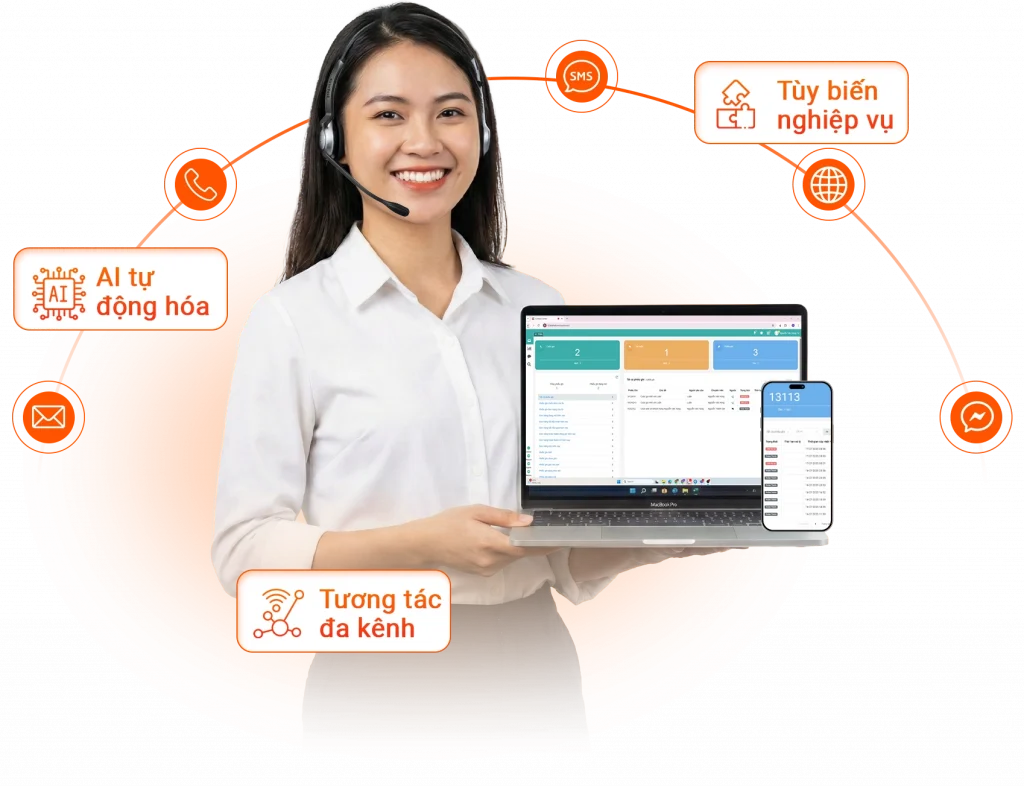
What businesses really need is not an AI tool on its own, but a system that is designed to follow its sales journey, in which AI serves as a support layer throughout. Call Center Software Integrating features such as Call AI, Auto Call, real-time monitoring, and automated QA are examples, but the real value lies in how these features are configured and operated to match the specific sales process, not in the software itself.
Experience of implementing AI Telesales at BSV
With nearly 20 years of experience operating projects telesales and telemarketing for B2B businesses, Bellsystem24 Vietnam AI Telesales approaches AI in a different way from SaaS software providers that sell licenses. Instead of selling a packaged AI product, BSV integrates AI as a layer of support throughout the project’s operation, from data mining and data cleansing at the input stage, to scenario suggestions during calls, and automatic QA after each call to ensure consistent quality across the entire team.
This approach has been proven through many AI-based CX projects, including: Multi-channel AI chat solution that automates customer care which BSV has implemented. With more than 300 business partners and 500,000+ interactions processed per day, BSV understands that effective AI Telesales does not lie in owning the technology, but in designing an operational process that combines human and AI capabilities to suit the specific characteristics of each industry.
Expected results when implemented properly
When deployed correctly, AI Telesales brings measurable improvements in key operational metrics.
- The connection rate increases thanks to AI that identifies the right time to call based on historical data.
- The cost per lead (CPL) is reduced thanks to filtering and cleaning the data right from the start, avoiding agent time wasted on potential leads that are not real.
- Average handling time (AHT) and time to record information after a call have been significantly reduced thanks to automated CRM summaries and updates.
In the long term, the conversion rate improves thanks to more consistent call quality through automated QA mechanisms, which helps management teams detect and fix weaknesses faster than traditional manual testing methods.
Conclusion
Implementing effective AI Telesales is not a matter of choosing software; it is a matter of redesigning the operational process with AI playing the right role of support at the right touchpoint, while humans remain the decision-makers at the crucial steps. Compliance with legal regulations and choosing the right products and services to implement AI are just as important as choosing the right technology.
Bellsystem24 Vietnam can support businesses in building and operating AI Telesales solutions tailored to the specific industry characteristics and individual sales journey. Contact the consulting team:
- Hotline: 1900 1739
- Email: contact@bs24vietnam.vn