
By combining voice recognition and language analysis, the automated call quality assurance system scores the entire or a large portion of calls according to the same set of criteria. Manager Contact Center This allows them to get a full picture of the service quality, and agents can receive early feedback instead of waiting until the end of the month for the evaluation.
This article explains what automated call QA is, how the system works, the scoring criteria, and the components, along with illustrative examples and tips for effective implementation.
What is automated call QA?
Automated Call Quality Assurance is a method that uses software to analyze and score the quality of calls between call center agents and customers based on a pre-defined scoring scorecard. Instead of call center agents having to listen to each call manually and score them, the automated call quality system converts voice into text, compares the content and characteristics of the call with the scoring criteria, and then returns the score and a list of calls that need to be reviewed.
Comparison between manual and automated QA
| Criteria | Manual QA | Automated call QA |
|---|---|---|
| Inspection scope | A small sample of calls | The entire call or a large part of it |
| Response speed | Usually at the end of the day or at the end of the semester | Almost immediately after the call |
| Consistency | Relatively speaking, it still depends on the assessment of each QA engineer. | Almost absolutely, the same criteria apply to all calls. |
| Costs as the scale increases | Increased significantly in the number of QA staff | Increase less |
| The role of the QA engineer | Listening and grading | Exception analysis, correction, reporting |
How does automated call QA work?
An automated call quality assurance system usually operates through five consecutive steps.
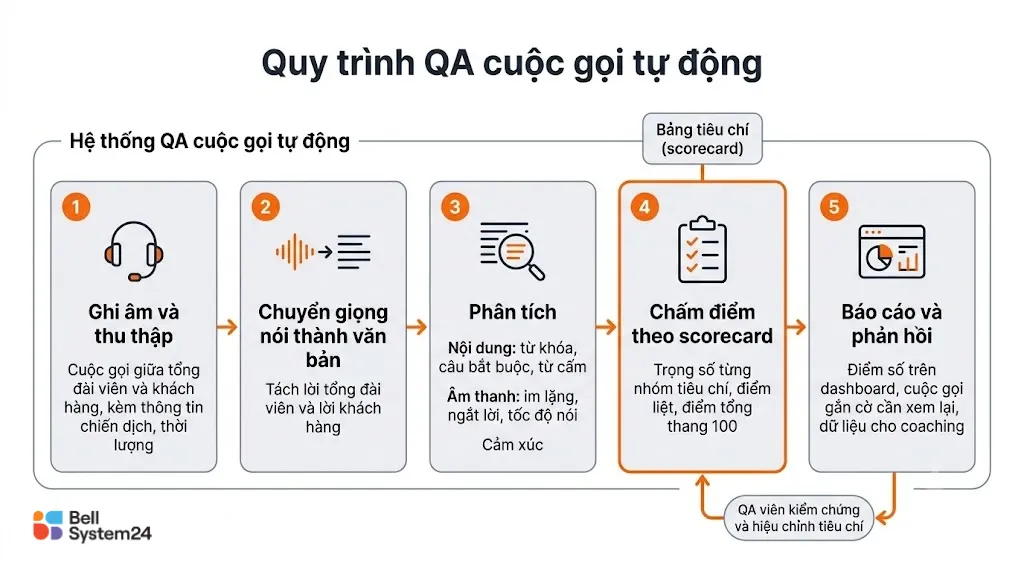
The first step is to record and collect data. The call is recorded from the call center and the associated information such as the responsible agent, duration, campaign, and type of call (inbound or outbound).
The second step is to convert the voice into text (speech-to-text) and separate the agent's words from the customer's words. Accuracy at this stage determines the quality of all subsequent steps, especially for languages with many regional accents and specialized terminology.
The third step is analysis. The natural language processing (NLP) system identifies advisory content, mandatory sentences, prohibited words, and the customer's intent. Audio analysis measures factors such as silence time, interruptions, and speech speed. Some solutions also analyze tone of voice and emotions (Sentiment analysis), but the accuracy in this part is not yet absolute, so it should only be used as a reference signal.
The fourth step is scoring. The analysis results are compared with the scorecard, with each criterion having its own weight, and then converted into a total score for each call.
The final step is reporting and feedback. The scores displayed on the dashboard, violations or under thresholds are flagged for review by QA engineers and team leaders, and the end-to-end data is used for coaching agents.
The scoring components in automated call QA
A scoring scorecard for effective calls requires three components: a set of criteria, a weight, and a score.
The table below is an example for reference. customer care call which we have applied to a CSKH project. The weighting needs to be adjusted according to the industry and the objectives of each campaign.
| Group of criteria | Criteria | Weighting |
|---|---|---|
| Introductory and concluding sections | Standard greeting, personalization, confirmation of customer information, summary, and thanks | 10% |
| Communication skills | Speed of speech, time of silence, not interrupting, sentences that show empathy | 25% |
| Business | The script is correct, the information is accurate, and there is enough mandatory content. | 30% |
| Problem solving | Identify the right needs, handle them thoroughly, confirm that the customer has understood, and finalize the next step. | 25% |
| Compliance | Read the required sentences completely; do not use forbidden words or encrypt information. | 10% |
The communication team is the hardest group to automate. The criteria are based on verbal content and audio metrics, such as mandatory sentences, taboo words, interruptions, or silence periods, for more reliable results than those based on tone of voice and emotions, which are currently not yet evaluated by the system with absolute precision. Therefore, the criteria regarding attitude should be concretized into observable behaviors, and the QA team remains the final validator.
Serious errors should be handled with a penalty point instead of just deducting points based on weightage. For example, call center agents providing misleading product information, disclosing personal information in a non-compliant manner, or showing a lack of respect for customers will result in a call being disqualified, regardless of how well other groups score. This avoids the situation where a call that violates serious standards still scores a high overall score.
The total score is usually converted into a 100-point scale and linked to action thresholds: the threshold to be achieved, the threshold requiring coaching, and the threshold requiring immediate review.
Note that, for the scorecard to be meaningful for management, the criteria groups should be linked to the business metrics that the organization is monitoring, such as: CSAT, FCR and others KPIs for customer care staff. The operational part should also be closely aligned. scenario for customer care via phone It has been standardized, because the system only scores correctly when the scenario and criteria are consistent with each other.
Example illustrating scoring a call
The example below is illustrative, to show how the scorecard works in practice. (This is not data from a specific project at BSV.)
A customer called the help desk to ask about the service maintenance fee. The call lasted 4 minutes and 30 seconds. The system recorded and scored as follows:.
| Group of criteria | Point | System comments |
|---|---|---|
| Introductory and concluding sections | 9/10 | Hello is correct, but there is no summary sentence at the end of the call. |
| Communication skills | 18/25 | Interrupting the customer twice, speaking quickly when explaining the fees |
| Professional activities and advisory content | 27/30 | Accurate information, a missing idea in the script |
| Problem solving | 20/25 | Not confirmed that the customer has understood, not decided on the next step |
| Comply with regulations | 10/10 | Enough imperatives; no forbidden words |
| Total | 84/100 | Dach, sign up for coaching in listening skills |
With the set threshold of 80 points reached, the call still goes through, but the system flags the communication group for the team leader to coach the agent on not interrupting and adjusting the speaking speed. With manual QA, this type of error is easy to miss if the call is not within the recorded template.
The problem becomes even clearer when operating on a large scale. With a 500.000 interactions are processed daily within the system of Bellsystem24 Vietnam (BSV), Manual testing is unlikely to cover the entire quality of the call. Call Center Software BSV's system must integrate automatic QA with real-time monitoring and advanced reporting for processing.
Two models of QA implementation: according to the scenario and with emotional evaluation
Automated QA has two main deployment directions.
The scenario-based QA model Compare the content of the call with the script and the established criteria; this is appropriate when the goal is to control compliance with business procedures.
The QA model has an emotional evaluation component. adds a layer of analysis of the agent's tone and emotions, but as mentioned, this part still achieves high accuracy but is not absolute due to the limitations of the technology; therefore, it should be used as a reference, and combined with the assessment of the QA staff.
In terms of cost, both models are usually priced as a package, consisting of two groups of items.
- One-time groups include the service initiation fee and the script or criteria setup fee.
- The monthly billing group includes maintenance fees based on call volume and recording storage fees, which are added when exceeding the limit. Since there is a minimum volume requirement under the plan, this form of billing is not suitable for businesses with small call volumes.
The impact of automated call QA on businesses
When applied correctly, automated call quality management brings four groups of benefits.
First is the coverage: Businesses can evaluate a large portion of calls instead of a small sample, thus detecting early issues that recur across campaigns, by shifts, or across agent teams.
The second is speed: It can be done immediately after the call, helping to get feedback to the agent in a short time, fixing the error before it becomes a habit.
The third is consistency: All calls are scored according to the same criteria, reducing disputes about how to score between QAers and between QAers and agents.
The fourth is risk control compliance., This is especially true in industries such as banking and insurance, where advice must be in accordance with regulations.
For outsourced contact center businesses, independent QA data also allows for performance comparisons between vendors on the same measure. This data is also the input for ancillary activities such as standardizing and improving conversational scripts, training and coaching agents, or designing blended models. AI call center, In this scenario, the bot receives the requests and the agent handles the complex cases.
How can automated QA be effective?
Build clear and measurable scorecard
This is the background that has a major impact on the scoring efficiency. Indeterminate criteria (such as good attitude) are very difficult for the scoring system to understand. Therefore, businesses should translate these into specific, measurable behaviors:
- Don't interrupt
- There is a statement confirming the need
- The speaking speed is within the allowed range.
- …..
Start with a moderate number of criteria and expand them gradually once you have verified their accuracy.
Coordinate with QA personnel during operation
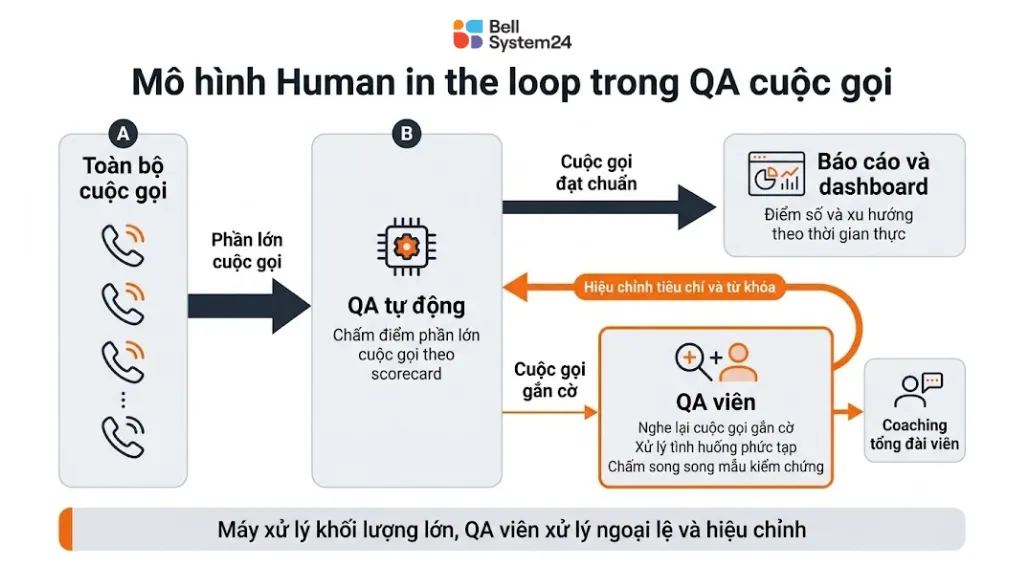
Automated QA does not completely replace human intervention; it is most effective when combined with human intervention (the human in the loop model). Periodically sample some calls to allow the QA team to compare the results with the system’s results (calibration), and then adjust the criteria and keywords if there are any deviations.
Link the scoring results to coaching
QA scores are only valuable when they lead to action. Team leaders should use the results to point out specific calls and specific behaviors that need improvement, during meetings. coaching It takes place regularly instead of just holding a final meeting at the end of the month.
Regular review and continuous improvement
Products, policies, and scenarios change over time, so the scorecard also needs to be updated periodically so that scores are not based on outdated standards.
Notes for implementation
First of all, it is necessary to understand the limitations of technology. Automated QA relies heavily on scripts and initial criteria; incorrect or ambiguous criteria will give incorrect scores across the entire call. The system also becomes inflexible when the business changes frequently, as each time a script changes, the criteria need to be updated.
Sound quality is the first condition. Background noise, low volume, or recording with crosstalk from both sides will reduce the accuracy of identification, so it is recommended to review the PBX infrastructure before deployment.
The linguistic accuracy needs to be verified on real data. Regional accents, local vocabulary, product names, and industry terminology all affect the results. Therefore, run pilots, measure the accuracy, and add terminology dictionaries before expanding.
Security and legal compliance are non-negotiable aspects, as the recording contains personal data of customers. Businesses need to inform customers about the recording, grant access rights, and store it in accordance with security standards such as ISO/IEC 27001, and review current regulations protecting personal data.
The integration system helps to link the QA points with customer and agent records in CRM, This ensures that the results are incorporated into the management process rather than being kept separate in a report.
Internal media determines the level of acceptance of the agent. Many agents may be concerned about being fully monitored, so it is necessary to publicly disclose the scoring criteria and emphasize that the goal is to support capacity development.
Finally, it is advisable to implement in stages: starting with a campaign or a group of agents, evaluating the results, and then expanding.
Frequently asked questions
Do automated call quality audits completely replace QA staff?
Not yet. The system can handle large volumes of data and measure various parameters; however, QA staff still needs to adjust the criteria, assess complex situations, and coach agents. Currently, BSV is running a human in the loop model for projects with large call volumes and has found that this is the most optimal model.
Does the system have Vietnamese-language call buttons for different regional accents?
Maybe, but the accuracy depends on quality of voice model training For Vietnamese language and recording quality. Businesses should run a pilot on real data before deploying it on a wider scale.
Does automated QA have the ability to evaluate the emotions and tone of an agent?
Yes, it is an AI QA solution, but the accuracy is not perfect at present. Therefore, businesses should prioritize criteria based on verbal content and audio measurements, and have QA staff verify emotional responses.
What scale should I deploy automated call QA for?
There is no fixed threshold. Typically, businesses need to consider whether the volume of calls is so high that manual QA can only check a small portion, or when the industry has high compliance requirements. Conversely, with small volumes, solution packages often apply a minimum monthly volume, so it is not cost-effective, and manual QA sampling remains the more practical option.
Conclusion
Automated call quality assurance helps businesses expand their quality control scope from a small sample to the vast majority of calls, with consistent criteria and faster feedback. The real value comes from combining technology with people: clear scorecards, periodic calibration, and data-driven coaching.
Bellsystem24 Vietnam can help businesses build their QA processes and deploy automated call QA on the Telehub platform. Contact the consulting team:
- Hotline: 1900 1739
- Email: contact@bs24vietnam.vn
- Contact form